Good post-surgery check-ins are short, daily and predictable. They ask the same few questions at the same time each day. They give the person recovering an easy way to say “I’m okay”, and they give you a clear rule for when to call the surgeon. The first two weeks at home are when most of this matters, especially if the patient lives alone. Below is how to set it up, what to ask, and where an app like ours fits.
TL;DR
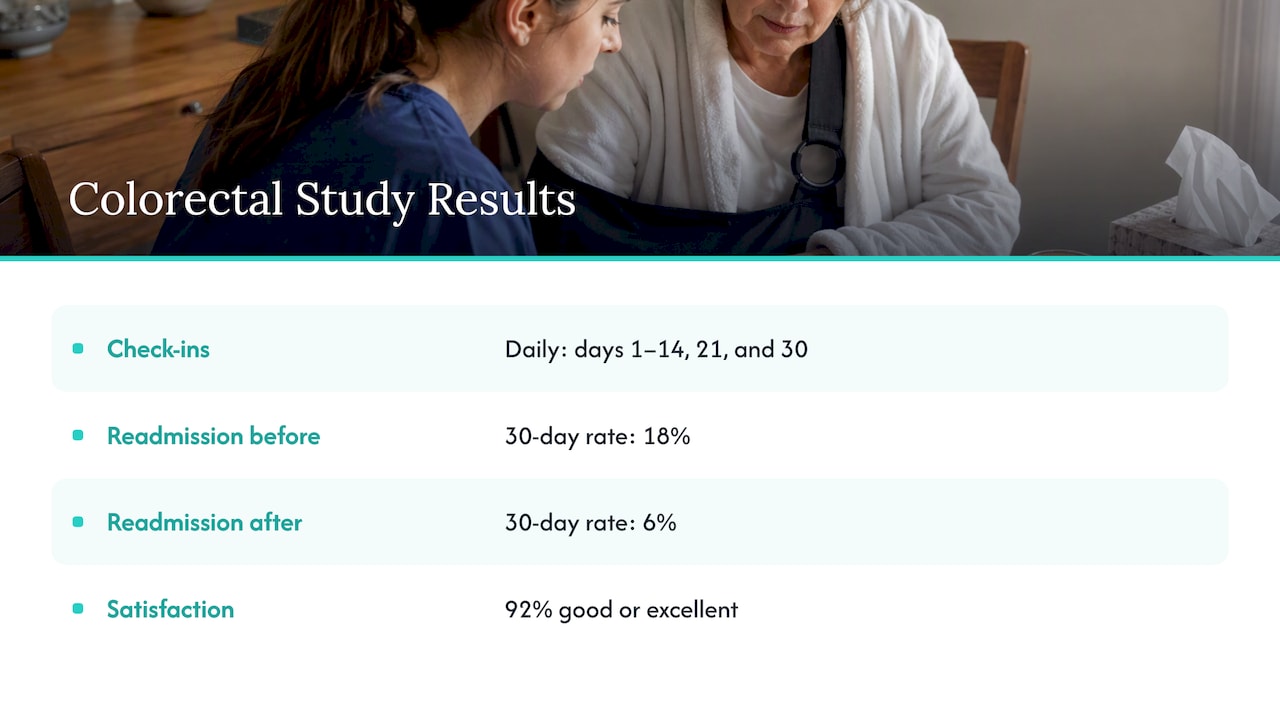
- Check in once a day for the first 14 days, then taper toward the 21- and 30-day marks. That is the schedule one colorectal surgery monitoring program used.
- Keep it to a few questions: pain, temperature, incision, medications, and “do you need anything?” Fatigue makes long forms a bad idea.
- Agree in advance on red flags that mean calling the surgical team: fever above about 101°F, pain that medication does not relieve, a changing incision, or bleeding that soaks the dressing.
- A one-tap confirmation plus a missed check-in alert covers the scariest gap: the patient who simply does not answer.
- An app supports the care team’s instructions. It never replaces them.
Table of Contents
- Why the first weeks at home are the risky ones
- What a post-surgery check-in actually is
- Build the check-in routine before surgery day
- The questions worth asking every day
- Red flags: when a check-in becomes a phone call
- Why “no answer” is the most important signal
- Transition home after surgery away from home
- Different recoveries need different check-in rhythms
- Our perspective: simple beats thorough
- Using Well-Check during recovery
- A simple two-week plan
- FAQ
- Sources
Why the first weeks at home are the risky ones
In the hospital, someone checks your vitals every few hours. At home, nobody does. The patient is tired, on new medications, and trying not to bother anyone. A small problem can sit for a day before anyone notices.
Clinical researchers describe this hospital-to-home transition as a vulnerable stretch. In the colorectal surgery program mentioned above, patients downloaded a mobile app before discharge. They then received a Daily Health Check on days 1 to 14, then on days 21 and 30. In that study, the 30-day readmission rate fell from 18% to 6%, and 92% of users rated their overall satisfaction as good or excellent. That was one study of one surgery type, run with a hospital team behind it, so do not treat the numbers as a promise for your family. They do show that a structured daily touchpoint is worth the effort.
The same logic applies to a family check-in, even without a hospital program. You are trying to catch the “this doesn’t look right” moment early, and you are trying to make sure a quiet phone does not go unnoticed.
What a post-surgery check-in actually is
People use the phrase for three different things, and mixing them up causes confusion.
- The surgeon’s follow-up visit. A scheduled appointment, usually in the first weeks, where the surgical team examines the incision and recovery. This is the medical check-up. Keep every one of them.
- Remote symptom monitoring from the care team. Some hospitals and surgical practices send patients daily questionnaires. Research on electronic patient-reported symptom monitoring after mastectomy looked at whether early symptoms predict 30-day complications, because this kind of reporting helps teams recognize problems sooner.
- The family check-in. What this article is mostly about: a daily, low-effort way for a spouse, adult child, neighbor or friend to know the patient is safe and to notice changes.
The family check-in does not diagnose anything. Its job is to notice, ask and escalate to the people who can diagnose.
Build the check-in routine before surgery day
The best time to set this up is before the operation, while the patient is rested and can say what they want. A few decisions to make together:
Pick who is on the list
Choose two or three people, not ten. One primary contact who gets the first alert, and one or two backups. Make sure each has agreed, has the surgeon’s office number, and knows the patient’s medication list. If your loved one is a senior, our guide to setting up emergency contacts on an iPhone walks through the phone side.
Pick the time
Choose a time when the patient is usually awake and not in the middle of pain medication drowsiness, such as mid-morning. Tie it to something that already happens, like breakfast and the morning pills. Then set a grace window. A check-in that is a few minutes late should not trigger a family panic, but one that is hours late should.
Write the red-flag rules on paper
Put the surgeon’s number and the rules on the refrigerator. Do not rely on anyone’s memory at 2 a.m. The next section covers what to include.
Decide how much visibility the patient wants
This is about dignity. Some patients are happy to share location and answers. Others want only a daily “I’m okay”. Agree on it up front, and write it down. Our piece on using a check-in app as a safety net rather than surveillance explains why we design around that principle.
The questions worth asking every day
Keep it to a handful of questions. Fatigue is the enemy of consistency. Research summaries on post-discharge monitoring point the same way: the systems that keep patients engaged are the ones that make responding effortless, such as simple one-tap answers or text-based replies.
A workable daily set:
| Question | Why it matters | What triggers a call to the surgical team |
|---|---|---|
| How is your pain, 0 to 10, and is your medication controlling it? | Pain that is rising or not relieved by prescribed medication is a recognized warning sign | Pain not controlled by what was prescribed |
| Have you taken your temperature? | Fever can signal infection | Above about 101°F, or a lower fever that lasts more than two days |
| How does the incision look? | Redness, swelling or discharge can mean infection | New redness, swelling, yellow or foul-smelling discharge, or an opening |
| Did you take your medications on schedule? | Missed or doubled doses are common after discharge | Confusion about doses: call the pharmacist or surgical team |
| Are you eating, drinking, moving, and going to the bathroom? | Basic function tells you a lot | Not keeping fluids down, severe constipation or diarrhea, trouble breathing |
| Do you need anything today? | Catches practical gaps (meals, rides, groceries) | Not a medical trigger, but answer it the same day |
If your caregiver role is mostly about structure, our article on one-tap daily check-in categories shows how to keep the question set short enough to be sustainable.
Red flags: when a check-in becomes a phone call
The family check-in should never be where a serious symptom is debated. Your surgeon’s discharge instructions come first. If they differ from anything here, follow theirs.
Medical references agree on the common warning signs. MedlinePlus discharge instructions (written for knee arthroscopy, but the warning signs are typical of many procedures) tell patients to call the surgeon for fever, pain that the prescribed medication does not relieve, redness, swelling or yellow drainage at the incision, or bleeding that soaks through the dressing. WebMD’s overview of postoperative fever adds that a slight fever is expected in the first two days, but fever higher than 101°F, a low-grade fever beyond 48 hours, pus, more swelling, a foul smell, or a tear in the incision are reasons to contact your doctor. It also lists coughing or vomiting blood, chest pain and problems breathing.
Some situations are not for a phone call to the surgeon’s office. Chest pain, severe trouble breathing, or a patient who is hard to wake or newly confused need emergency services. Call 911. Do not wait for the next scheduled check-in.
A practical rule for families: if you would hesitate about whether to call, call. Surgical offices expect these calls. Clinicians themselves describe the goal of check-ins as catching complications early without flooding the team, so having your own notes ready (temperature, time, what the incision looks like, a photo if the office accepts them) makes the call faster and more useful for both sides.
Why “no answer” is the most important signal
A missing reply is often the first sign something is wrong, and it is also the thing a phone call or text thread handles worst. If you text your father at 9 a.m. and he does not respond, is he asleep, in the shower, or on the floor? You find out only by calling, then calling again, then perhaps driving over.
This is the gap a missed check-in alert fills. The patient taps once. If the tap does not come within the agreed window, the people on the list are notified and can act. If that sounds like your situation, our explanation of what a grace period means in a wellness check shows how the timing works and why we keep it forgiving.
And if you are weighing a check-in app against a wearable pendant or a device, our medical alert app versus device comparison covers how to choose by real habits. Research on bariatric surgery has made a related point: wearable monitors help safety, but on their own they are often not enough. The strongest approach combines device data with the patient actually reporting how they feel.
Transition home after surgery away from home
If surgery happened in another city or country, the first days at home are even more fragile, because the surgical team is far away. That is true for any patient who travels for care. This guide to post-op care after returning home is a good example of why a regular monitoring routine matters once you are back and your care team is hours away. In that situation, agree beforehand with the surgeon’s office on how to reach them, what they want to see if there is a concern, and which local clinic or urgent care you would use for a problem.
Different recoveries need different check-in rhythms
Not every patient needs the same intensity.
- Same-day surgery, patient lives alone. Daily check-ins for at least the first two weeks, with a backup contact within driving distance. A second, short evening check is worth it for the first three nights.
- Joint replacement or orthopedic surgery. Falls are the main concern when mobility is reduced. Pair daily check-ins with a plan for what happens if the patient is unable to get up. Our fall detection guide for iPhone explains the grace period and one-tap checks. Consistent follow-up also matters for the rehabilitation side, as this piece on follow-up during joint recovery describes.
- Older adult with a new medication list. Medication reminders are as important as symptom questions. See how to schedule medication reminders that seniors and caregivers can rely on.
- Recovery with a spouse at home. You may need less frequent checks, but a plan for when the spouse is out of the house is still smart.
After the first two weeks, taper to the pace the care team and the patient are comfortable with. Our article on check-in frequency for seniors discusses when to move from daily to a lighter rhythm.
Our perspective: simple beats thorough
We built Well-Check around one belief: a check-in people actually complete beats a thorough one they skip. After surgery, a person is tired, sore and often a little embarrassed to need help. Asking them to open a form with twelve fields is asking them to fail.
So the core of the app is a single “I’m okay” tap and a single help tap. Everything else is built around that moment. If the tap does not come, the emergency contact network you set up is alerted. Medication reminders handle the drug schedule, so the family does not have to nag. GPS and smart caregiver analysis are there for the cases where they truly help, and we want them used with the patient’s consent, not behind their back.
We do not diagnose, and we are not a replacement for your surgeon, a nurse line, or 911. Think of the app as the part of recovery that answers “is my mom okay today?” quietly, so that you save your phone calls for the moments that need conversation. The best check-in leaves the patient feeling cared for, not watched.
— Brian
Using Well-Check during recovery
Well-Check gives you a daily check-in, medication reminders, missed check-in alerts to a network of emergency contacts, and one-tap help. Two plans are published: Essential at 5.99 USD per month and Complete at 7.99 USD per month. You can compare them on our pricing plans page. Recovery is usually a few weeks, so many families start the app before surgery and set up contacts while the patient is still feeling like themselves. For a wider setup, our senior safety checklist can be completed in one sitting.
A simple two-week plan
- Before surgery: Choose two or three contacts. Save the surgeon’s office number and after-hours line in everyone’s phone. Print the red-flag list. Set the check-in time and grace window.
- Day of discharge: Review the discharge instructions together. Ask the nurse what to watch for and who to call. Confirm the medication schedule and set reminders.
- Days 1 to 3: Check in morning and evening if the patient lives alone. Ask about pain, temperature and incision. Expect a slight fever early on, but do not guess: use the thresholds from the surgeon.
- Days 4 to 14: One check-in a day. Keep a short note of temperature and pain trends so you can share them with the surgical team.
- Days 15 to 30: Taper if recovery is going well, and keep every scheduled follow-up appointment.
- Afterward: Turn off what you no longer need. Dignity includes ending monitoring when it is no longer needed.
FAQ
How do you check in on someone after surgery?
Ask the same few questions at the same time each day: pain, temperature, incision, medications and whether they need anything. Make replying effortless, ideally a one-tap answer or a short text. If they do not reply within the time you agreed, call, and have a backup person ready to visit.
How often should you check in after surgery?
Daily for the first two weeks is a sound default, and one monitoring program used daily checks on days 1 to 14, then days 21 and 30. The patient living alone may benefit from an extra evening check for the first few nights. Your surgeon’s instructions always take priority over any general schedule.
What is a checkup after surgery called?
It is usually called a postoperative visit, post-op visit or post-op follow-up. The surgeon examines the incision and recovery and answers questions. Daily family check-ins are a separate, informal layer that does not replace these appointments.
When should I call the surgeon instead of waiting for the next check-in?
Call for fever above about 101°F, pain that prescribed medication does not control, redness, swelling or yellow drainage at the incision, or bleeding that soaks through the dressing. Call 911 for chest pain, severe trouble breathing, or a patient who is hard to wake or suddenly confused.
Sources
- Home to Stay: An Integrated Monitoring System Using a Mobile App to Support Patients at Home Following Colorectal Surgery
- Remote Symptom Monitoring with Clinical Alerts Following Mastectomy
- Knee arthroscopy discharge, MedlinePlus
- Postoperative Fever: Causes, Diagnosis, and Treatment, WebMD
- Beyond the Healthdot: Same-day Discharge and Remote Monitoring in Bariatric Surgery