A safe return plan for dementia is a written, rehearsed set of steps that tells everyone what to do before a person wanders, in the first minutes after they are missing, and after they come home. Write it at diagnosis, not after the first scare. Wandering can happen at any stage of the disease, and the people around the person need to know their jobs before the door opens.
This guide walks through the plan we recommend families put on paper: reduce the risk, prepare the information police will ask for, set up alerts, rehearse the first 15 minutes, and plan the return itself. It also covers what to do if the person lives alone or spends part of the day alone, which is the question behind many searches for an elderly home alone emergency plan.
TL;DR
- About 6 in 10 people with dementia will wander and become lost at least once, and wandering can happen at any stage, so plan from diagnosis.
- Prepare a one-page information sheet (photo, diagnosis, routes, dominant hand, devices) before you need it.
- If you cannot find the person quickly, call 911. Do not search alone for a long time first.
- Combine layers: home changes, ID on the person, a check-in and alert system, a neighbor network and a relationship with local police.
- Rehearse the plan twice a year and after any change in behavior, medication or living situation.
Table of Contents
- Why every family needs a plan before the first incident
- Know the warning signs and triggers
- Step 1: Make the home harder to leave and easier to live in
- Step 2: Put identification on the person
- Step 3: Prepare the information sheet before you need it
- Step 4: Build the alert layer, including for someone who is home alone
- Step 5: Know the first 15 minutes cold
- Step 6: Know what to do when you find them
- Perspective: what we have learned building for independence
- Where Well-Check fits in your plan
- Step 7: Build your network and rehearse
- When the plan says it is time for more support
- FAQ
- Sources
Why every family needs a plan before the first incident
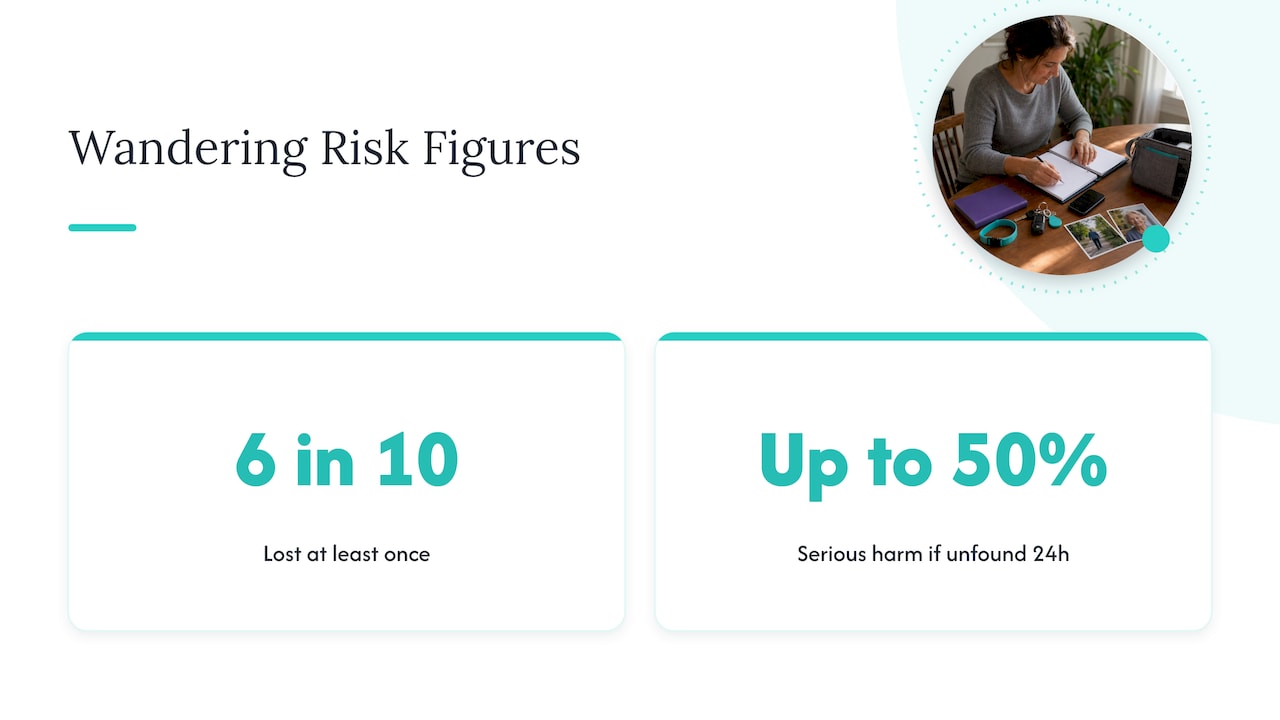
The numbers are blunt. The Alzheimer’s Association reports that about 6 in 10 people living with dementia will wander and become lost at least once, and many do it repeatedly. It also reports that if the person is not found within 24 hours, up to half will suffer serious injury or death.
Two things follow from that. First, speed matters more than anything else you can control. Second, deciding what to do in the middle of a crisis is the worst possible time to decide. A wandering preparedness guide from a search-and-rescue research group makes the same point: even with good prevention at home, critical wandering can still occur, so the response plan has to exist beforehand.
A common mistake is to treat wandering as a late-stage problem. The Alzheimer’s Association notes that it can occur at any stage and that caregivers often underestimate the risk. A person who still drives, cooks and holds a conversation can still walk out of the house at dusk looking for a workplace they retired from years ago.
Know the warning signs and triggers
A plan is stronger when it is built around the particular person. Spend a week noting patterns, then write them down.
- Time of day. Late afternoon and night are common. If evenings are the risk, our guide to stopping 2 AM wandering covers the night shift in more detail.
- Statements. Phrases such as “I need to go to work” or “I’m going home” (while at home) signal a search for a past routine.
- Restlessness. Pacing, checking doors, picking up keys or a coat.
- Triggers. Hunger, pain, a full bladder, noise, a new caregiver, a change of room or a recent hospital stay.
- Dominant hand. The Alzheimer’s Association says that wandering patterns often follow the dominant hand, so search teams use it to choose a direction. Write down whether the person is right- or left-handed.
Also record the places that pull them: a childhood home, a former workplace, a church, a favorite park, a bus stop. These go on the information sheet later.
Step 1: Make the home harder to leave and easier to live in
The National Institute on Aging advises that changing the environment is often more effective than trying to change behavior. The goal is safety without making the home feel like a locked ward.
Practical changes to consider:
- Place locks or latches out of the person’s usual line of sight, such as high or low on the door.
- Use visual barriers or a door that blends into the wall, and a simple door chime so you hear exits.
- Keep shoes, coats, purses and keys out of sight, since these cue the idea of leaving.
- Give the person safe places to walk: a fenced yard, a hallway loop, a garden bench. The Alzheimer Society of B.C. recommends that caregivers enable safe wandering as one of five areas, because pacing itself is not always the problem.
- Post emergency numbers and the home address near every phone.
That same Canadian guidance is honest about the limits: no single measure prevents wandering, so several strategies are needed together. Treat the home changes as layer one, not the whole plan. Our living alone safety checklist gives a room-by-room routine you can adapt.
Step 2: Put identification on the person
The NIA’s wandering guidance says to make sure the person carries some kind of ID or wears a medical bracelet. A person with dementia may not be able to say their name, address or diagnosis to a stranger or an officer.
Use more than one form, because bracelets get removed and wallets get lost:
- A bracelet or pendant with name, a caregiver’s phone number and the word “dementia”.
- A card in the wallet or purse.
- A sewn-in or iron-on label inside a favorite coat or jacket.
- A phone with a lock-screen note or emergency contact that is reachable without a passcode.
If your family uses an iPhone, our walkthrough for setting up emergency contacts on iPhone takes about five minutes.
Step 3: Prepare the information sheet before you need it
This is the step families most often skip, and the one that saves the most time. Search-and-rescue researchers describe a pre-filled wandering information sheet that lowers the load on a caregiver who is frightened and exhausted. Police can act on accurate details immediately.
Keep one page, printed and also saved on your phone, with:
| Item | What to write |
|---|---|
| Recent photo | Taken within the last few months, clear face, plus a full-length shot in typical clothing |
| Identity | Full name, nickname they answer to, age, height, weight, hair and eye color |
| Diagnosis and health | Type of dementia, medications, mobility, vision and hearing, conditions that make hours outdoors dangerous |
| Behavior | How they react to strangers, whether they respond to their name, whether they may hide or resist help |
| Handedness | Dominant hand |
| Places | Past homes, workplaces, favorite walks, bus routes, places of worship, friends’ addresses |
| Technology | Any GPS device or phone, app names, how to access the location |
| Contacts | Everyone on the call list, in order, with a backup for each |
| Last seen | A blank line for time, place and clothing, completed in the moment |
The IACP’s recommendation is that police work with families as partners in proactive planning, including a pre-written script for the 911 call. A script can be as simple as: “My [relation] has dementia and is missing. Last seen at [place] at [time], wearing [clothing]. Right-handed. Photo and information sheet are ready to send.”
Our caregiver emergency binder guide shows how to organize this sheet with medical records and legal papers so the first five minutes of any emergency go smoothly.
Step 4: Build the alert layer, including for someone who is home alone
Many people with early or moderate dementia live alone or are alone for hours each day. For them the plan has to detect a problem without a caregiver in the room. This is also the core of any emergency plan for an elderly person home alone: something has to notice when routine breaks.
A layered setup usually has these parts:
- A daily check-in. A simple tap on a phone that says “I’m okay.” A missed check-in is useful information, because it can mean a fall, a medical event or a walk out of the house.
- Automatic alerts to a named network. If the check-in is missed, the people on the list are notified in order. Our piece on family emergency alerts you can test in under an hour explains how to test this.
- Location. Knowing where the phone is can narrow the search. Read about how accurate GPS is outdoors before you rely on it.
- A neighbor who knows. One trusted neighbor with your number and a key shortens the time to a visual check.
- Emergency Siri or SOS settings. If the person can still use them, enable Emergency SOS on iPhone.
Be honest about what an app can and cannot do
An app on a phone only helps if the phone travels with the person. Someone with dementia may leave it on the kitchen counter, let the battery die or not understand the prompt. That is why a phone-based system is one layer, not a guarantee. It works best in early and middle stages, where the person can still carry and use a phone, and as a way for family to know about a routine that has gone wrong. If the person no longer reliably carries a phone, you need a wearable or a person on site, and you may want to pair a check-in app with a monitored medical alert. Our guide on choosing between a medical alert app and a device helps you decide by real habits rather than by marketing.
Location sharing also needs consent and dignity. Agree on it with the person while they can still take part in the decision, and read our privacy nonnegotiables for senior GPS apps before turning anything on.
Step 5: Know the first 15 minutes cold
This is the part to rehearse. The Alzheimer’s Association advises that search efforts should begin immediately. Many people who wander on foot are found within about 1.5 miles of where they were last seen, and police should be called if the person is not found within 15 minutes of starting a search. If the person is in obvious danger, or it is night, cold, hot or stormy, do not wait the 15 minutes.
A minute-by-minute script
- Minutes 0 to 5. Check the house, yard, garage, closets and car. Look in places a person might hide or sit down. Send one family member through the immediate neighborhood.
- Minute 5 to 10. Call the next person on your list. Open your location tool if the person carries a phone or device. Pull out the information sheet.
- By minute 15 at the latest. Call 911. Say the words “dementia” and “missing, vulnerable adult”. Give the last seen time and place, clothing and dominant hand. Offer the photo.
- After the call. Stay at the home base so someone is there if the person returns, and keep a phone line free.
The IACP background guidance adds a caution worth taking seriously: do not search alone for long stretches. Searching alone, especially at night or in rural areas, can lead to your own injury or disorientation and can scatter the search area without coordination. A few minutes of checking is natural. A long solo search is not.
Silver Alerts and other specialty alerts
Ask the officer whether a regional alert applies. The IACP reports that the Silver Alert is active in 37 states and is typically used when a person aged 65 or older with dementia is missing and in imminent danger, though criteria differ by jurisdiction. Some states use other names, such as Florida’s Purple Alert. Check your own state’s rules in advance and put the criteria on the information sheet.
Step 6: Know what to do when you find them
The IACP’s promising-practices guidance for law enforcement stresses a calm approach: approach in a calm, friendly manner and avoid sudden movements. Families can use the same principle.
- Approach from the front, slowly, and say who you are. Use their name.
- Do not scold, argue or ask “why did you leave?” They may not know.
- Join them first. Walking alongside for a moment, then suggesting a ride or a warm drink, often works better than insisting they return.
- Check for injury, dehydration, heat or cold exposure, and call a medical professional if anything looks wrong. After any time outdoors, a visit to the person’s doctor or urgent care is sensible.
- Tell everyone on the list and the police right away so the search stops.
Afterward, hold a short review. What was the trigger? Which step ran slowly? Update the sheet and change the home setup where the exit happened.
Perspective: what we have learned building for independence
We built Well-Check for a specific problem: older adults who live alone, and the families who lie awake wondering about them. Dementia sharpens that problem, and we want to be direct about where a check-in app fits.
It fits early on, when the person wants independence and the family wants to know that today’s routine happened. A one-tap “I’m okay” is respectful because it asks little of the person, and a missed check-in turns a silent worry into a prompt for a phone call. It does not replace a plan, a neighbor, a door chime or a conversation with the police.
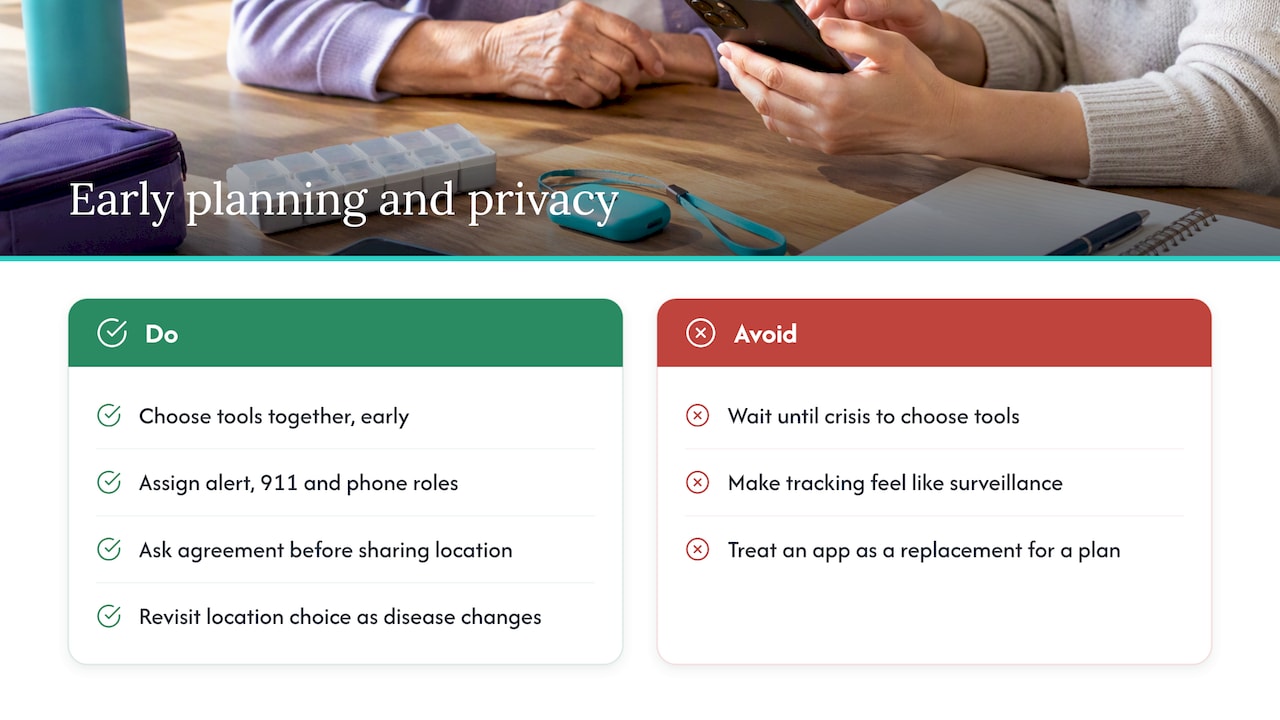
The mistake we see most is waiting for a crisis to pick tools. The families who cope best decide together, early, who gets the alert, who calls 911 and who stays by the phone. Our guide to caregiver roles and responsibilities lays that division of labor out, and our 45-minute family meeting plan helps relatives who live far away take part.
We also believe tracking should never feel like surveillance. Share what location features do, ask for agreement while the person can give it, and revisit the decision as the disease changes. Dignity and safety are not opposites, but you have to design for both.
— Brian
Where Well-Check fits in your plan
Well-Check gives the person a one-tap “I’m okay” check-in, medication reminders, GPS location and alerts to an emergency contact network when a check-in is missed. Our smart caregiver analysis is designed to help cut false alarms, which matters because a network that cries wolf soon stops reacting.
The Essential plan is 5.99 USD per month and the Complete plan is 7.99 USD per month. You can compare both on our pricing page and decide which suits the person’s routine. If you are starting from scratch, our 3 moves to start a safety plan for seniors tonight is a quick way to begin.
Step 7: Build your network and rehearse
A plan nobody has read is not a plan. Do these things this month:
- Call your local non-emergency police line. Ask whether they keep a registry or file for vulnerable residents and what they want in advance.
- Brief the neighbors. Give one or two nearby people your number, a photo and permission to call you if they see the person outside alone.
- Assign roles. Who calls 911, who drives, who stays home, who contacts relatives.
- Run a drill. Test the alert chain, the check-in and the 911 script once without the person present. Fix what is slow.
- Schedule a review. Every six months, and after a hospital stay, medication change or move.
- Get support. The Alzheimer’s Association 24/7 Helpline at 800-272-3900 is free and staffed around the clock, and clinicians there can help you tailor a plan.
If the person lives in assisted living or memory care, ask the facility for its elopement procedure. The ECRI toolkit on hazardous wandering notes that a returning-resident procedure after a hospital stay is often overlooked, a good question to put to any community you are considering.
When the plan says it is time for more support
Some signs mean the current setup is no longer enough: repeated exits at night, getting lost in familiar places, leaving the stove on, missing check-ins several days a week, or the person not carrying a phone. These are not failures. They are information. Respond by adding a person on site, changing the schedule, adding a wearable, or discussing a higher level of care with the doctor and family. Keep the person’s wishes at the center of that conversation for as long as they can express them.
FAQ
What should a safe return plan for dementia include?
It should include home changes that reduce exits, identification on the person, a ready information sheet with photo and details, a call list, a 911 script and a set of roles. Add an alert layer such as check-ins or location sharing, and a schedule to rehearse and update it.
When should I call 911 if someone with dementia is missing?
The Alzheimer’s Association says to call if the person is not found within 15 minutes of starting your search. Call immediately if the weather is bad, it is dark or the person is at high risk. Do not keep searching alone for a long time before calling.
Can a phone app keep someone with dementia from getting lost?
No app can prevent wandering, and a phone helps only if the person carries it. A check-in and location app can alert family to a missed routine and help narrow a search. Use it as one layer with home changes, ID and neighbors.
What is a Silver Alert?
It is a public alert for a missing older adult, often one with dementia, who is in imminent danger. The IACP reports it is active in 37 states, and criteria vary by jurisdiction. Ask local police how it works in your state.
What is a good emergency plan for an elderly person home alone?
Start with a daily check-in, a short list of people who are alerted if it is missed, emergency numbers by the phone and a key with a nearby neighbor. Add medication reminders, a written information sheet and a plan for who calls 911. Test it every few months.
Sources
- Alzheimer’s Association: Saved by a Bark
- Alzheimer’s Association: Wandering
- Alzheimer’s Association: Staying Safe
- Alzheimer’s Association: 24/7 Helpline
- National Institute on Aging: Home Safety and Alzheimer’s Disease
- National Institute on Aging: Coping With Alzheimer’s Behaviors: Wandering and Getting Lost
- Alzheimer Society of B.C.: Wandering and dementia
- Alzheimer’s Wandering Incident Preparedness
- IACP
- IACP: Promising Practices to Address Wandering
- ECRI: Hazardous Wandering and Elopement Toolkit