A missed check-in protocol is a short written plan that says who does what, in what order and by what time when a person living alone does not confirm they are okay. The best ones are boring and specific: a first nudge to the person, a call from a named human, a call to a second contact, and only then a request for a welfare check. This guide gives you a working version for an older adult, the reasoning behind each step, and the mistakes that make protocols fail.
TL;DR
- A missed check-in is a signal, not a verdict. Most are a forgotten phone or a nap, so the protocol should start gently and escalate on a clock.
- Safety standards for lone workers use an escalation ladder: contact attempts within about 5 to 10 minutes, then the emergency plan if there is no answer.
- Name a primary responder who is actually reachable. Do not leave it to a loose group chat.
- Write the plan down, share it with everyone on it, and test it once before you need it.
- Calling 911 is for emergencies in progress. For a quiet worry, a non-emergency police line can arrange a welfare check.
Table of Contents
- What a missed check-in actually means
- The escalation ladder
- Who should be on the other end
- Setting the check-in schedule around real risk
- What the research says about doing this with older adults
- Beyond “I’m okay”: make the alert useful
- When to call 911 and when to request a welfare check
- Common ways protocols fail
- Our perspective
- Putting the protocol into the app
- A one-page template to copy
- FAQ
- Sources
What a missed check-in actually means
A daily check-in is a promise with a deadline: “I’ll tell you I’m fine by 9 a.m.” When the deadline passes with no confirmation, you have one fact and many possible explanations. The phone is in another room. The person is at breakfast. Or something has gone wrong, such as a fall, a medical event or confusion.
You cannot tell these apart from the alert alone. That is why a protocol matters. Without one, families improvise at the worst moment: three siblings call the same number, nobody calls the neighbor, and an hour disappears. With one, every person on the list knows their single job.
The term comes mostly from workplace safety. Organizations that send people to work alone in remote places have used missed check-in procedures for decades, and the logic transfers well to an older parent living alone. A university lone worker guidance document lists the basic components of a policy: communication, check-in intervals, missed check-in procedures and designated check-in individuals. Those four pieces are also the skeleton of the family version below.
The escalation ladder
The core idea is an escalation ladder: a fixed sequence of contact attempts, each with a time limit, ending in an emergency response. The U.S. Bureau of Reclamation’s lone and remote worker safety policy is a good model. In that kind of protocol, a first attempt to reach the person happens within minutes of the missed check-in, a second attempt follows shortly after, and if both fail the emergency response plan starts, including notifying emergency contacts or requesting a wellness check.
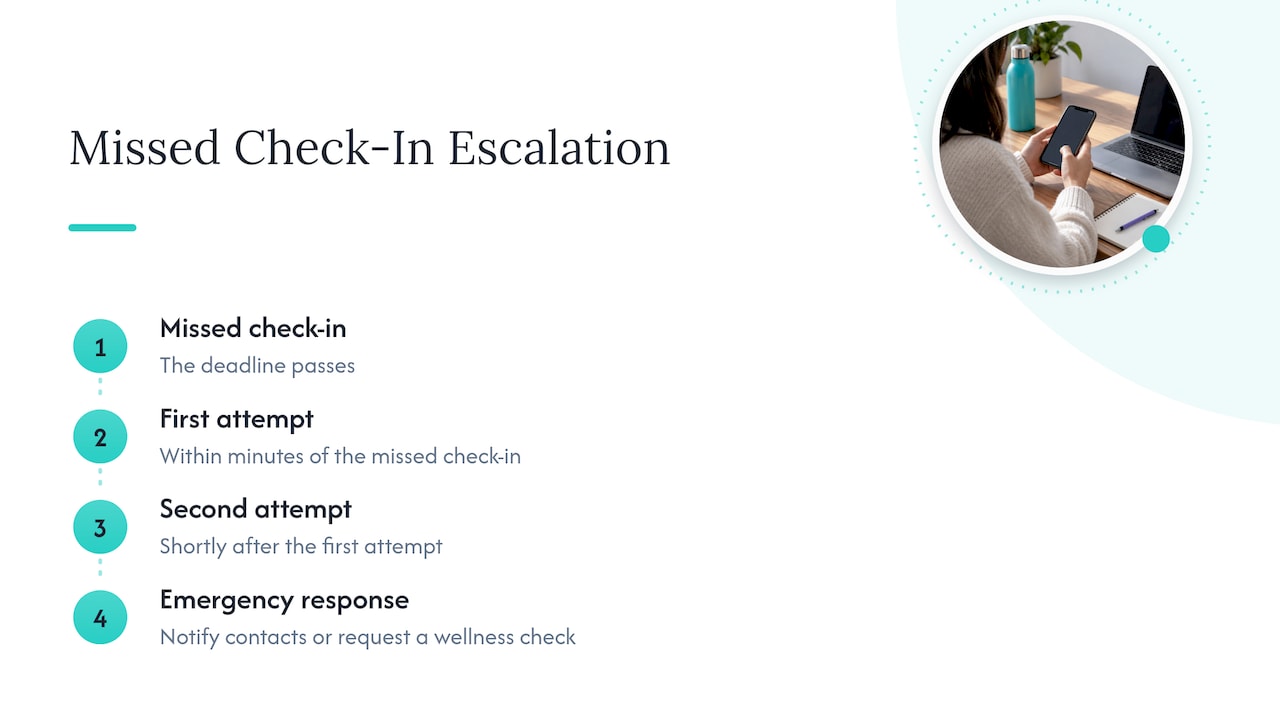
Workplace timelines are tight because the risk is high. A senior at home with a fully charged phone and a predictable routine can reasonably have a longer first window. What stays the same is the shape: every step has an owner and a deadline, and nobody waits for someone else to decide.
A sample timeline for an older adult
Adjust the minutes to your parent’s health, routine and how far away you live. Treat this as a starting draft, not a medical standard.
| Time after the missed check-in | What happens | Who does it |
|---|---|---|
| 0 minutes | App reminder and alert to the person: “Are you okay?” | The app |
| 5 to 10 minutes | Phone call to the person, then a text | Primary contact |
| 15 to 20 minutes | Second call. If no answer, call the backup contact | Primary contact, then backup |
| 20 to 30 minutes | Backup or a nearby neighbor goes to the door, if safe and agreed in advance | Backup contact |
| 30 minutes | No contact and no explanation: request a welfare check from local police, or call 911 if you have reason to think it is an emergency | Primary contact |
The Bureau of Reclamation document is clear that contact methods should be multiple and pre-defined, such as notification, then phone, then email. For a senior, the equivalent is app, then call, then text, then a person at the door.
We lay out a four-step version of this in more depth in our guide to an emergency contact escalation for families.
Who should be on the other end
The weakest point in most family protocols is not the technology. It is the person who receives the alert.
The lone worker guidance from the University of Idaho says that on-call or casual individuals should not be the primary contact. The signal should go to a designated person or position who is actively staffed and can act at once. Loosely defined networks tend to fail in real emergencies.
For a family, that translates into three rules:
- One primary responder per time window. If your sister works nights, she is primary for mornings and your brother covers afternoons. Do not alert everyone equally and hope.
- A backup who is physically close. A neighbor with a spare key is worth more than a daughter two states away, at least for the first 30 minutes.
- A third contact for gaps. Phones die, people board planes. Have someone who can step in.
If you are still working out who does what in the family, our piece on caregiver roles and responsibilities walks through it.
Setting the check-in schedule around real risk
A protocol is only as good as the check-in it reacts to. Safety professionals note that checking in only at the start and end of a shift is an unacceptable policy in most professional settings. Intervals should match the person’s risk and activity, with more frequent check-ins in higher-risk periods.
For an older adult, higher-risk hours are usually predictable: first thing in the morning, medication times, and night. A single noon check-in leaves a long gap in which a fall could go unnoticed. If you manage a facility or a team of aides, the same thinking applies to staff workflows, and mobile checklists for care teams show how to set up recurring tasks and pilot them over 30 to 90 days.
Two practical tips:
- Tie check-ins to an activity. Research on a proactive telecare system found that task-associated check-ins can feel less invasive than rigid clock times, which helps people keep using the system. “Tap when you’ve made your coffee” beats “tap at 8:00 sharp.”
- Start light. If the schedule feels like surveillance, your parent will quietly stop. Our guide to how many check-ins seniors need each week covers when to automate and when a human call is better.
What the research says about doing this with older adults
A 2025 feasibility randomized controlled trial of a proactive telecare system tested a daily “OK” button with older adults living at home. The escalation in the trial is a useful template. When someone did not press the button, a call center team tried to reach them. If they could not be reached, the system contacted their nominated emergency contact, and emergency services were involved only as a last resort when critical risks were perceived.
The study reported a retention rate of 90.9% (30 of 33 participants), which suggests older adults can keep up a daily check-in routine when the system fits into the home and a human follows up. It was a small, 8-week feasibility study, so read it as encouraging rather than conclusive.
The authors’ broader point matches what families report: the system works when it is simple and when a real person is available to chat or troubleshoot.
Beyond “I’m okay”: make the alert useful
A bare missed check-in tells you nothing about where to send help. The same research notes that smarter protocols also review the last known location and, where permissible, use device-based data like GPS so responders have a head start. If you plan to use location, decide the rules in advance and tell your parent. Our pieces on privacy rules for senior GPS apps and on when location sharing becomes stalking cover consent and boundaries.
Also write down what a responder needs to know at the door:
- Your parent’s address, door or gate code, and where a spare key is kept
- Current medications and major conditions
- Name of the primary doctor and preferred hospital
- Whether pets are in the home
- Anything that explains a false alarm, such as a planned trip or hospital visit
A short senior safety checklist can hold all of this in one place.
When to call 911 and when to request a welfare check
The last step of the ladder is where families hesitate most, so decide in advance.
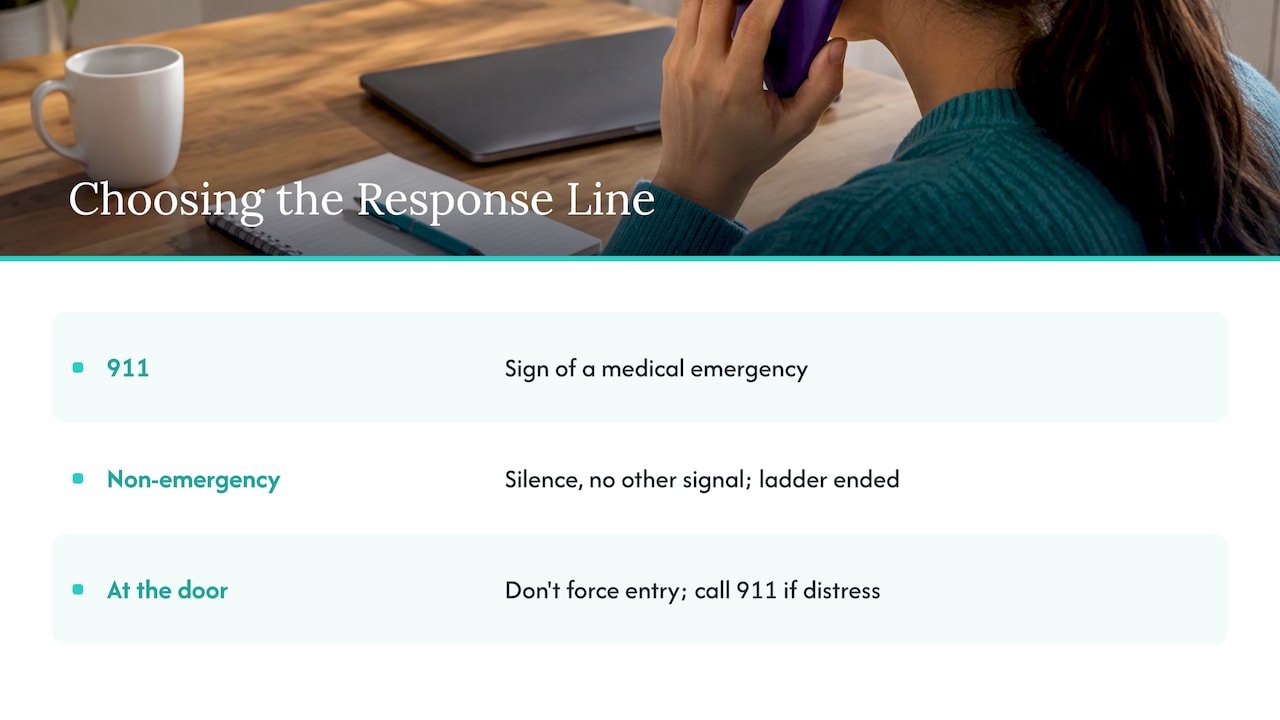
A welfare check, also called a wellness check, means police visit a person’s home to make sure they are okay. Requests typically come from family, friends or neighbors after someone stops answering. According to this explainer on police welfare checks, you can call 911 if you believe an emergency is in progress, and you can also reach police through a non-emergency number. Which line applies in your parent’s town depends on the local department, so look up the number for their city or county now and store it in the protocol.
A reasonable rule: call 911 if you have any sign of a medical emergency, such as a garbled voicemail, a known fall, or a parent who said they felt unwell. Use the non-emergency line when there is silence and no other signal, but your ladder has run out. When unsure, choose the faster option. Embarrassment is cheaper than a long delay.
If you are the one at the door, do not force entry. Wait for responders unless you can see someone in distress through a window and have to act, in which case call 911 first.
Our article on the meaning of a wellness check and the 30 minute grace period explains how that final step fits with a grace period.
Common ways protocols fail
Everyone is alerted, so no one acts. The bystander effect is real in family group chats. Name one owner per step.
The primary contact is unreachable. Add a backup and a time limit: if the primary has not acknowledged within five minutes, the alert moves on.
Check-in fatigue. Daily taps that feel like chores get ignored, then the alerts become noise. The remedy is simplicity, activity-based timing and an easy way to pause for planned trips.
The empty check-in. A tap that is automatic tells you little. Occasional human contact, a call or a visit, keeps the loop honest.
An untested plan. Phone settings can silently block alerts. On iPhone, for instance, a stuck prompt can hide notifications, and we show how to fix a stuck critical alerts prompt. Run a drill: have your parent skip a check-in on purpose one afternoon and watch what happens. Our guide to testing family emergency alerts takes under an hour.
Dignity gets lost. Tell your parent exactly what the plan is, who is on it and what triggers each step. A plan done with someone is accepted. A plan done to someone is resented.
Our perspective
We built Well-Check around a simple belief: a safety tool should protect independence, not replace it. A missed check-in should not feel like an accusation. It should feel like a friend saying, “Hey, just checking, are you okay?”
That is why the app is designed around one-tap “I’m okay” confirmations and a customizable contact network, so the first nudge goes to the person, and the people they chose come next if there is silence. In our experience, the families who have the best outcomes are not the ones with the most features switched on. They are the ones who agreed on the plan together before anything happened, picked a primary and a backup, and tested it.
If you take one thing from this article, take this: write the ladder down with times and names today. The technology only delivers the signal. The protocol decides what happens next.
— Brian
Putting the protocol into the app
Well-Check handles the first rungs of the ladder for you: daily check-ins, missed check-in alerts to your emergency contacts, medication reminders and GPS, with an emergency contact network you build yourself. The Essential plan is $5.99 per month and the Complete plan is $7.99 per month; you can compare them on our pricing plans page. If your parent lives alone and you want the daily routine to run without nagging, see how the older adult check-in app works.
A one-page template to copy
Paste this into a shared note and fill in the blanks.
- Check-in time or trigger: ______ (for example, 8:30 a.m. or after morning coffee)
- Grace period before alert: ______ minutes
- Step 1: App reminder to ______
- Step 2 (within ___ minutes): Primary contact ______ calls, then texts
- Step 3 (within ___ minutes): Backup contact ______ calls. Neighbor ______ checks the door if agreed
- Step 4 (within ___ minutes): Request welfare check from ______ (local non-emergency number), or call 911 if there is any sign of an emergency
- At the door: key location, door code, medications, doctor, pets
- Review date: every 3 months or after any change in health
Review it after any fall, hospital stay or change in medication. A protocol that matched your parent’s health last year may be too loose now.
FAQ
What happens if you miss a check-in?
In a well-designed protocol, the person gets a reminder first, then a named contact calls, then backups are alerted, and finally a welfare check or emergency call happens if nobody can reach them. The speed of each step depends on the person’s risk. For workplace lone workers, standards call for contact attempts within roughly 5 to 10 minutes.
How long should you wait before acting on a missed check-in?
There is no single number for seniors. A common approach is a short grace period of 10 to 30 minutes, longer for someone with a stable routine, shorter for someone with recent falls or health changes. Ask your parent’s doctor if you are unsure how tight to make it.
Who should be the emergency contact for a missed check-in?
Choose people who can actually respond: they live nearby or have flexible schedules, and they keep their phones on. Avoid making a casual or on-call person the only primary contact. Always name a backup.
Is a missed check-in the same as a welfare check?
No. A missed check-in is the trigger. A welfare check is one possible final step, in which police visit the home. Most missed check-ins end with a phone call and a relieved laugh long before that point.
Sources
- U.S. Bureau of Reclamation: Lone Worker and Remote Worker Safety
- University of Idaho: EHS Guidance, Lone Worker
- Using a Proactive Telecare System to Support Independence, Health, and Well-Being in Older Adults: Feasibility Randomized Controlled Trial
- What Is a Police Welfare Check?