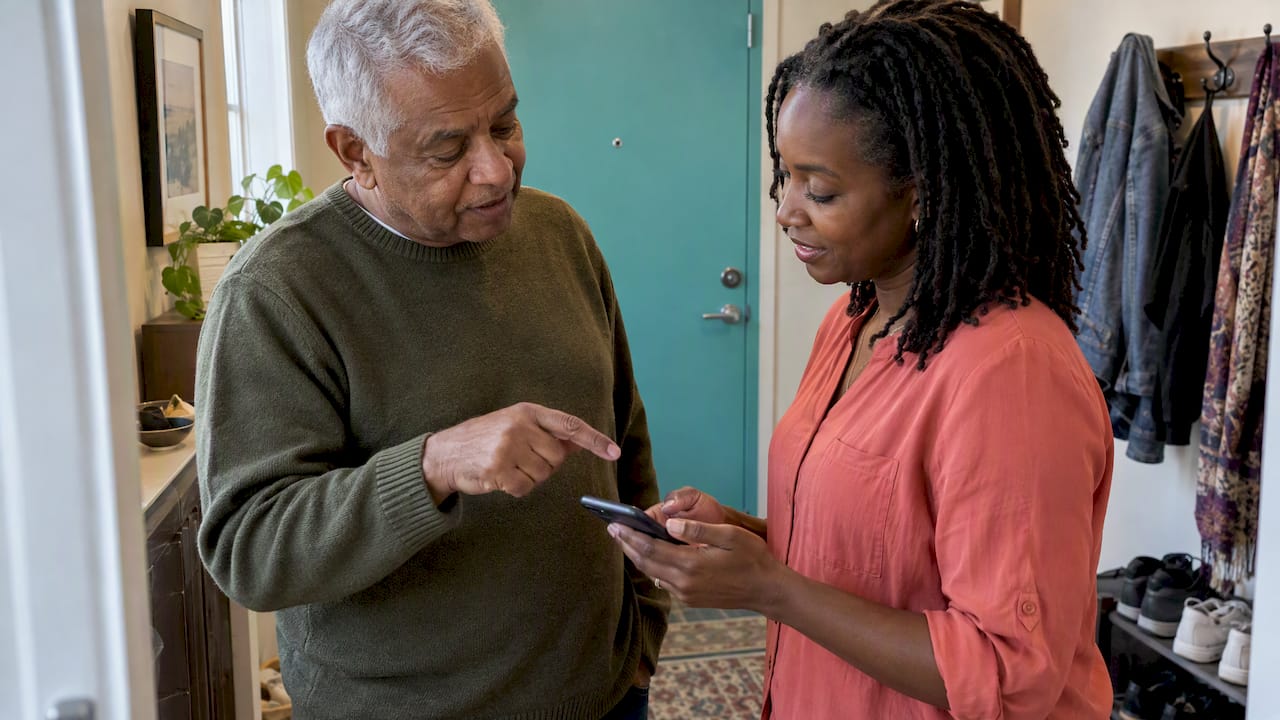
Tracking an older parent should start with a conversation, not an install. Real consent means they understand what is collected, who sees it and why, and they say yes freely. It is ethically sound, it is the approach official guidance points to, and it is the only version that keeps working, because a parent who agreed will keep the app on and a parent who was never asked will find a way to switch it off.
This guide covers what valid consent contains, how to run the conversation, what to do when memory loss limits the person’s ability to decide, and how to keep monitoring light enough that it protects independence instead of eroding it.
TL;DR
- Valid consent has four parts: clear information, the person’s capacity to decide, understanding, and a voluntary choice.
- Treat it as a dialogue about benefits and risks, not a form your parent signs to make you feel better.
- Agree in advance on what is shared, with whom, and how your parent can pause or end it.
- With dementia, capacity can shrink over time. Involve the person as far as possible and bring in their doctor and legal representative for the rest.
- Monitoring never replaces visits, calls or proper care.
Table of Contents
- Why consent comes first
- The four parts of valid consent
- Consent is a dialogue, not a signature
- What to agree on and write down
- Consent for each person who is affected
- Data protection rules, by region
- Dementia and consent
- Keeping monitoring from becoming surveillance
- Perspective: independence without surveillance
- Setting it up once you have a yes
- FAQ
- Sources
Why consent comes first
Location and activity data is personal data. European case law treats GPS location data as personal data because it reveals where a person is and how they move, and tracking it interferes with the right to respect for private life. That is a European legal standard, not a U.S. rule. In the United States, rules on location tracking, recording and surveillance differ from state to state and depend on who is tracked, how, and in what setting. If you are unsure, an elder law attorney in your state can tell you where the lines are.
The ethical case does not depend on the law. Researchers working on digital tools that monitor mobility and behavior have asked whether the usual medical consent frameworks protect people outside clinical settings, and home monitoring by family is exactly that gray zone. No clinician is in the room, so the conversation you have is the safeguard.
There is also a practical reason. A tracker that is resented gets left on the dresser. One that was chosen together stays on, gets charged and gets used.
The four parts of valid consent
The CEN/CENELEC guidance on monitoring technology says a valid informed consent process needs four main elements: disclosure of information, the capacity of the person (or their representative) to decide, comprehension of that information, and a voluntary decision. Here is what each looks like at a kitchen table.
| Element | What it means in practice | A question to ask yourself |
|---|---|---|
| Disclosure | Tell them what the app collects (location, check-in times, medication confirmations), who can see it and how long it is kept | Could my parent repeat this back in their own words? |
| Capacity | They can weigh the choice and reach a decision | Is memory or health changing how they take in new information? |
| Comprehension | Plain language, no jargon, time to ask questions | Did I explain it once or did we actually talk? |
| Voluntariness | They can say no, or say yes with conditions, without pressure or guilt | Would they feel safe declining? |
The last row is the one families skip. If the choice is “agree to tracking or move to assisted living,” it is not voluntary. Offer a real alternative, such as a daily check-in with no location at all, and mean it.
Consent is a dialogue, not a signature
The same guidance describes informed consent for monitoring as shared decision-making, a dialogue about benefits and risks between the person providing care and the person receiving it. The idea of weighing benefits and risks together is also at the heart of clinical consent, which is why guides on informed consent scripts and state rules in telehealth are a useful comparison: the best versions are conversations, with the paperwork only recording what was agreed.
How to open the conversation
Start with the worry, not the technology. “I lie awake when I can’t reach you after a fall in the news” lands better than “I’m putting an app on your phone.” Then ask what they would want. Many older adults are happy to confirm they are fine each morning and far less happy about a map that shows every errand.
A few openers that work:
- “What would make you feel safe living on your own?”
- “If you didn’t answer by mid-morning, who would you want us to call first?”
- “What would you never want shared, and with whom?”
Listen to the answers and change the plan. A parent who sees their input reflected in the setup is far more likely to say yes.
Start with the least intrusive option
Official guidance for long-term care says residents and families should explore less intrusive interventions first, such as care conferences, before turning to electronic surveillance. The same logic works at home. A phone call at a set time, a neighbor who waves, or a daily “I’m okay” tap may solve the problem without any location data. Add GPS only if there is a specific risk it addresses, such as getting lost or a history of falls outdoors.
What to agree on and write down
A one-page family agreement avoids most later conflict. Write it with your parent, in their words where possible, and keep a copy each. It should settle:
- What is collected. Check-ins only, or location too? Medication confirmations?
- Who sees it. Name the people. Not “the family,” but Maria and Tom, and nobody else unless your parent agrees.
- When it is used. For example, location is viewed only after a missed check-in, not browsed for fun.
- How to pause. Your parent should be able to turn sharing off for a day, a doctor visit or a private errand. Guidance for care settings lists letting the person turn the device off among the ways to protect privacy, along with limiting who can see the data.
- When you will review it. Needs change. Put a recurring date on the calendar to ask whether it still feels right, and drop it if it does not.
If you want a ready structure, our six-field location sharing agreement walks through the same ground, and our guide to three privacy nonnegotiables for senior GPS apps shows what to check in any app before you ask for consent.
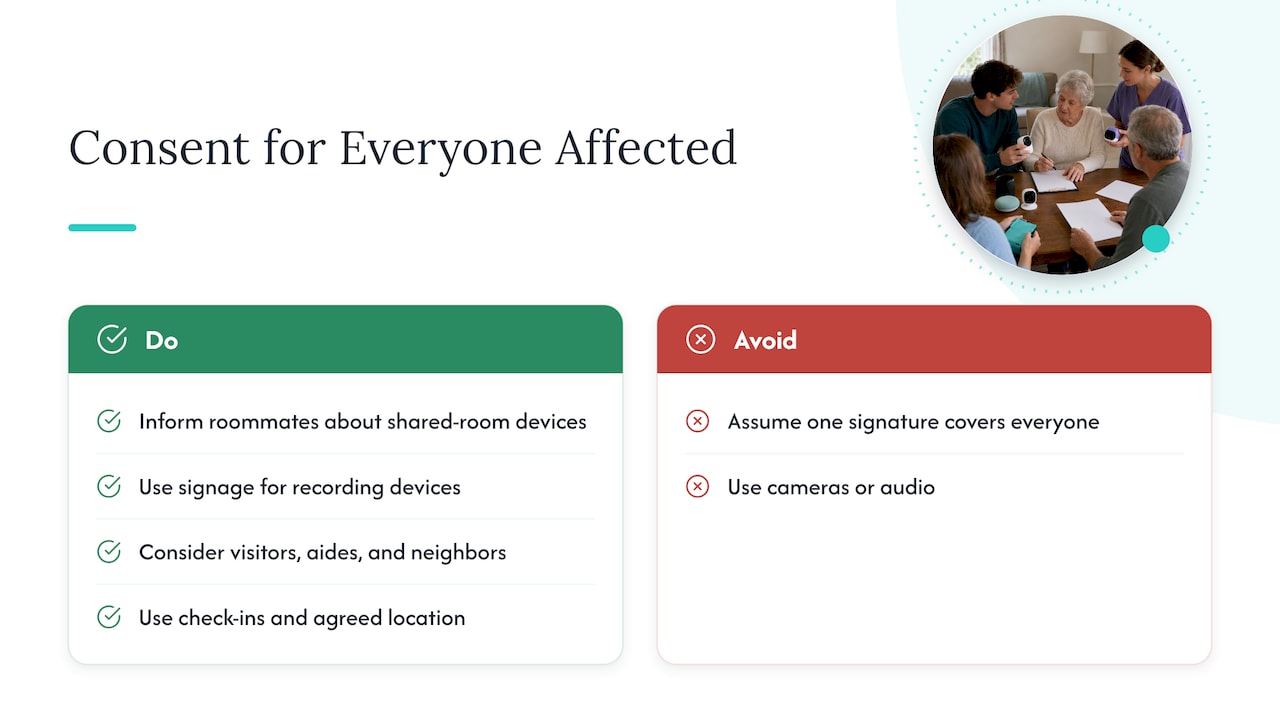
Consent for each person who is affected
Tracking can touch more people than your parent. In care facilities, guidance says that when a device sits in a shared room, the roommate must be informed and consent, because their privacy matters too, and that signage should tell others about a recording device, especially where people expect privacy. A phone app that shares location does not record the room, but the principle carries over: cameras and microphones in a bedroom or bathroom involve visitors, aides and neighbors, not only your parent. Policies on monitoring in shared rooms and intimate areas in home care make the same point: a signature from one person does not cover everyone in the space.
For most families, the simplest way to respect this is to avoid cameras and audio entirely, and keep to check-ins and, if agreed, location.
Data protection rules, by region
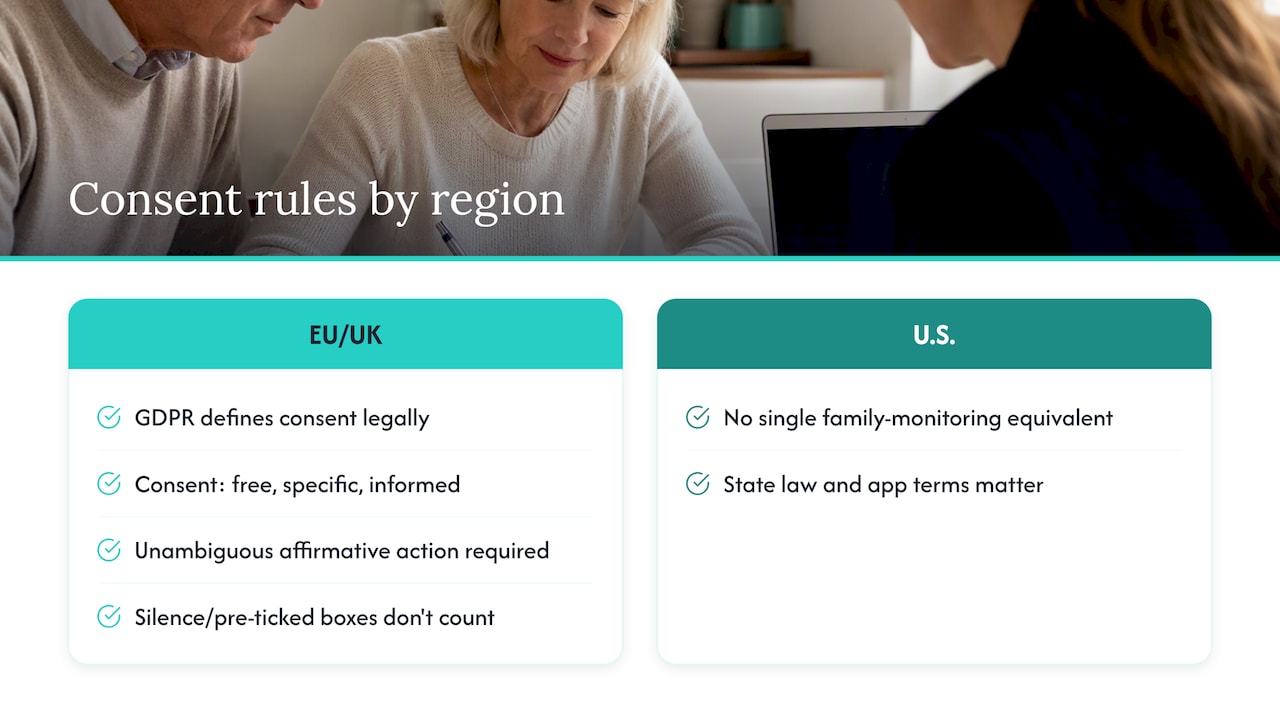
If you live in the EU or UK, or you serve people there, consent has a legal definition. Under the GDPR, consent must be freely given, specific, informed and unambiguous, shown by a clear affirmative action. Silence or a pre-ticked box does not count. In the U.S. there is no single equivalent covering family monitoring, so state law and the terms of the app you use matter more. The safe habit is to meet the stricter standard anyway: be specific about what is shared, make agreement an active step, and keep a record.
International human rights principles apply too. Research on assistive technology notes that the right to privacy for people with dementia, regardless of where they live, is protected under international conventions that prohibit unacceptable interference with privacy or communications.
Dementia and consent
Searchers often ask: can a person with dementia give informed consent, and can you put a tracker on them? The honest answer is that it depends on the stage, and on the decision.
Early in the condition, many people can understand and decide. Capacity is specific to the choice, so a person may be able to agree to a wearable and still struggle with a complex financial decision. Treat your parent as able to decide until their doctor says otherwise, and give them information in short, repeated, calm conversations.
Later, the picture changes. A 2025 ethics review found that people with advanced dementia are typically unable to decide about sensor-based surveillance, and that medical staff and, where available, relatives or guardians may decide based on the person’s presumed or documented wishes. That standard is worth holding on to: you are not choosing what is convenient for you but trying to reconstruct what your parent would have wanted.
Some practical steps:
- Ask early. Record your parent’s views on tracking while they can still give them, ideally alongside other planning documents.
- Involve their doctor. A clinician can assess capacity for this specific decision.
- Know who has legal authority. If your parent named a health care agent or has a guardian, that person decides when capacity is lost. An elder law attorney can confirm who that is in your state.
- Keep the person in the loop anyway. Even when you decide for them, explain what you are doing and watch for distress, which is a signal to rethink.
Researchers also warn that over-monitoring can have negative effects on independence and autonomy for people with dementia. The goal is the least monitoring that keeps them safe. If wandering is the concern, read our guides on preventing wandering in dementia and night wandering.
Keeping monitoring from becoming surveillance
Tracking that began with consent can still drift. Official guidance for care settings says devices should never be considered a replacement for personal involvement, visitation or adequate staffing, and families should treat an app the same way. A missed check-in alert is a reason to call and visit, not a substitute for doing so.
A few guardrails:
- Look at location when there is a reason, not out of habit.
- Share access with as few people as possible.
- Do not use what you see to criticize ordinary choices, like where your parent had lunch.
- Review the arrangement on the date you set, and honor a change of mind.
- If sharing ever feels controlling, read our piece on when location sharing becomes stalking.
Perspective: independence without surveillance
We built Well-Check around a simple belief: safety and dignity are not a trade. Most seniors who live alone do not want to be watched. They want someone to notice if something goes wrong. That is why the app centers on a one-tap “I’m okay” check-in, missed check-in alerts to a contact network your parent helps choose, and optional features like medication reminders and GPS, rather than constant visibility.
Our advice to families is to let consent shape the setup. Begin with check-ins. Add location only if there is a reason your parent understands and accepts. Keep the circle small. Revisit it. And never let an app stand in for a phone call. Features such as smart caregiver analysis exist to cut false alarms, so that when you do get an alert, it is worth acting on, and your parent is not interrupted for nothing.
— Brian
Setting it up once you have a yes
Once your parent agrees, put the agreement into the app settings so the technology matches the conversation. Well-Check offers two plans: Essential at $5.99 per month and Complete at $7.99 per month, with details on the pricing page. Start with only the features you discussed. If you want help choosing between an app and a device, our guide to picking a medical alert app or device by real habits helps you decide, and our senior safety checklist covers the rest of the setup in one sitting.
Then test it together. Send a practice alert, let your parent see exactly what you see, and confirm that they know how to pause sharing. People trust what they can see, and that trust is the whole point.
FAQ
Do I need my parent’s permission to track their phone?
Yes, as a matter of ethics and good practice, and in many situations as a matter of law. Rules vary by state and by the kind of monitoring, so check with an elder law attorney if you are unsure. Asking also makes the tracking work better, since your parent is more likely to keep the app on.
Can a person with dementia give informed consent to being tracked?
Sometimes. Early on, many people can understand and decide, and capacity depends on the specific decision. In advanced dementia, people are typically unable to decide, and doctors and legal representatives may decide based on the person’s presumed or documented wishes.
Can you put a tracker on someone with dementia?
You can, but how you do it matters. Involve the person as far as possible, ask their doctor about capacity, and make sure the person with legal authority agrees if they cannot. Choose the least intrusive option that addresses the actual risk.
What should a family agree on before starting?
Agree on what is collected, who sees it, when it is used, how your parent can pause it, and when you will review the arrangement. Write it down and keep copies. A short, specific agreement prevents most conflicts.
Is tracking a replacement for visiting?
No. Official guidance for care settings is clear that electronic devices should not replace personal involvement or adequate care. Treat an alert as a prompt to call or visit.
Sources
- CEN/CENELEC CWA 17502:2020, guidance on monitoring technology and informed consent
- Wisconsin Board on Aging and Long Term Care, Use of Electronic Monitoring and Recording Devices
- Ethics of Sensor-Based Surveillance of People with Dementia
- Assistive technologies for people with dementia: ethical considerations
- Care Quality Commission, Find out if you need consent to use technology as part of someone’s care
- European Court of Human Rights, Guide on case-law of the Convention: Data protection



[…] How to ask for and agree on senior tracking consent […]