Non-intrusive monitoring means keeping an eye on a person’s safety without putting a device in their way, a camera in their living room or a stranger at their door. For an older adult living alone, the most practical form is a daily check-in the person controls: one tap says “I’m okay,” and family hears something only when that tap does not come. Well-Check is built around that idea, with plans at $5.99 per month (Essential) and $7.99 per month (Complete).
A note on the term: searching “non-intrusive monitoring” also turns up engineering papers on non-intrusive load monitoring, a method for working out which appliances run in a building from one electricity meter. That is a different subject. This article is about people: how families, caregivers and older adults can stay connected without constant surveillance.
TL;DR
- Non-intrusive monitoring means the person being supported stays in charge: they check in, and family acts only on a missed check-in or a request for help.
- Nearly 3 in 10 adults 65 or older lived alone in 2022, so the need is common and the dignity question is real.
- The best setups pair a simple daily check-in with medication reminders, a short emergency contact list and clear rules about what happens after a missed check-in.
- Agree on the system together, before anything goes wrong. Consent is what keeps monitoring non-intrusive.
- Well-Check offers one-tap check-ins, missed check-in alerts, medication reminders, GPS tracking and smart caregiver analysis from $5.99 per month.
Table of Contents
- What “non-intrusive” should mean for a person, not a building
- Why so many families are asking about this now
- The main ways to monitor, from least to most intrusive
- How a check-in based system works
- Set it up so it stays non-intrusive
- Location sharing: where the line sits
- Fewer false alarms, fewer interruptions
- A note on the other meaning of the term
- What this looks like in a real week
- Who this approach fits
- Where to start
- Our perspective
- FAQ
- Sources
What “non-intrusive” should mean for a person, not a building
In engineering, the word has a precise sense. One university report defines non-intrusive monitoring as using equipment that needs no renovation, modification or visible presence in the home. The same idea carries over to people, with one addition: the monitoring should also not take over the person’s day.
For a senior living alone, a non-intrusive system has four traits:
- The person acts, the system does not watch. A tap on a phone is a choice. Constant observation is not.
- Silence is the default. Family gets no stream of updates. They hear when something is off.
- Everyone knows it exists. The older adult helped choose it and knows who gets notified.
- It fits a routine they already have. A morning check-in next to the coffee takes seconds and feels like habit, not oversight.
When those four are true, monitoring protects independence. When they are not, it tends to get switched off, ignored or resented, and then it protects no one.
Why so many families are asking about this now
The numbers explain the urgency. The U.S. Census Bureau reported that nearly 3 in 10 adults 65 or older lived alone in 2022, and among those 75 and older about 43% of women lived alone. Living alone is not a problem in itself. Many older adults prefer it and manage well. But it does mean that if a fall, a missed dose or a sudden illness happens, nobody in the house notices.
Isolation adds to the risk. A National Academies report summarized in a peer-reviewed overview links social isolation and loneliness in older adults with a higher likelihood of early death, dementia and heart disease, and names living alone as one of the factors that raise the risk. A daily check-in is not a cure for loneliness. It does create a small, reliable moment of contact every day.
The same worry reaches beyond older parents. Busy professionals who live alone, college students away from home and residents of assisted living or retirement communities all want someone to notice if they go quiet, without having someone hover.
The main ways to monitor, from least to most intrusive
It helps to place options on a spectrum. Where a method falls depends less on the technology than on how much privacy the person gives up.
| Approach | What the person does | What family sees | Intrusion level |
|---|---|---|---|
| Scheduled phone call | Answers a call | Whether the call was answered | Low, but depends on both people remembering |
| App check-in with one tap | Taps “I’m okay” | A confirmation, or an alert if it is missed | Low |
| Check-in plus reminders and optional location | Taps, takes medication prompts, may share location | Check-in status, and location when enabled | Low to moderate, controlled by consent |
| Continuous in-home sensors | Nothing, but is always sensed | Activity patterns inside the home | Moderate to high |
| Cameras or microphones in rooms | Nothing, but is always watched | Live or recorded images and audio | High |
Phone calls work until someone is busy or travelling. Cameras and microphones capture far more than a safety check needs. For most older adults who are still active and want to remain independent, the middle of the table is the sweet spot: enough signal to act on, little enough that it feels respectful.
How a check-in based system works
The logic is simple and worth understanding, because it is the reason the approach is both light and dependable.
- The person has a check-in window. For example, between 8 and 10 a.m.
- One tap confirms they are fine. No typing, no menus. The app is designed so that older users can do this at a glance.
- If the window passes without a tap, the app alerts the emergency contacts. That is the trigger for a human to make a call.
- A help button is always available. If something is wrong, one tap asks for help instead of waiting for a missed check-in.
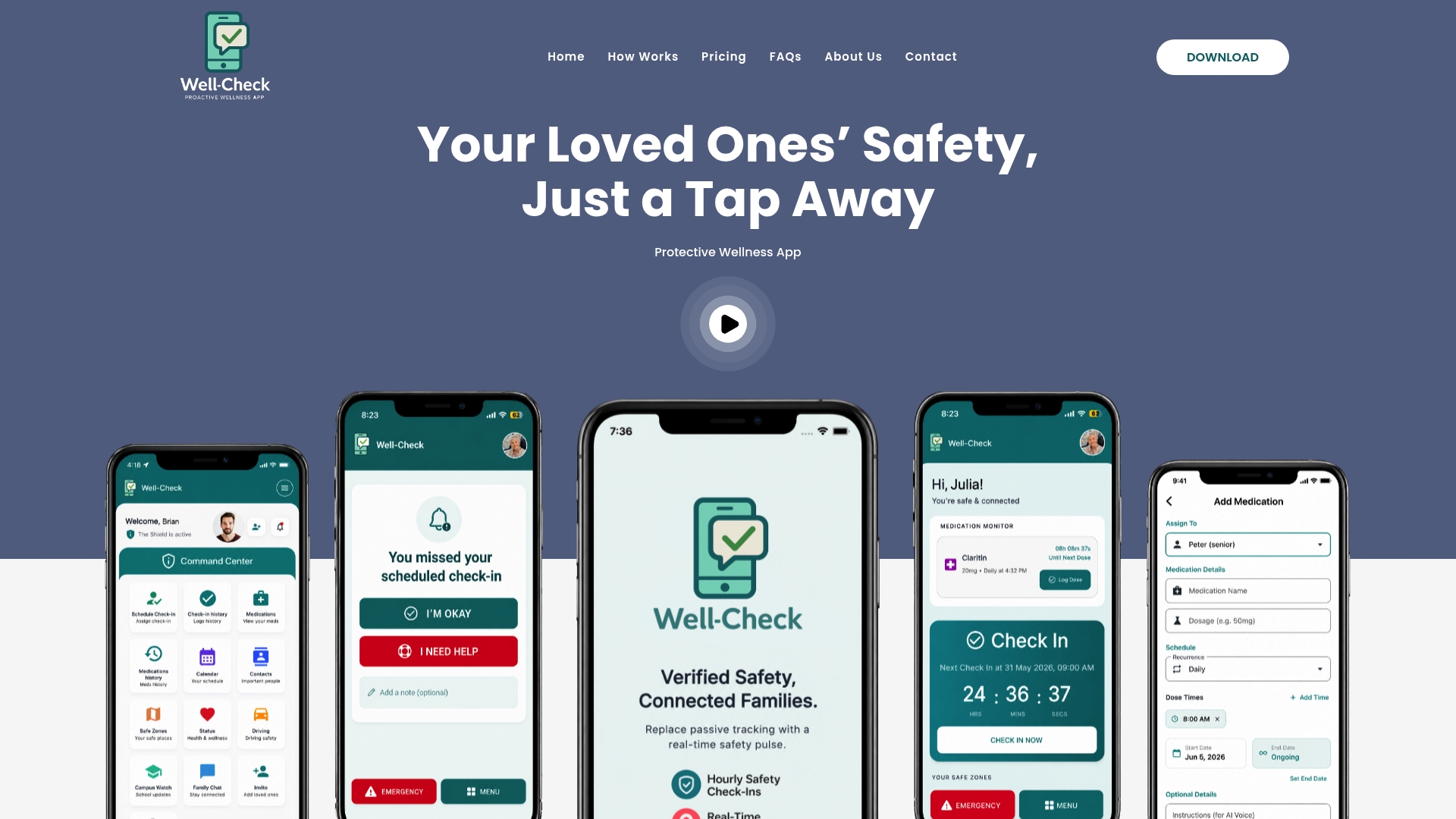
This is the design we use at Well-Check: daily check-ins, one-tap help and “I’m okay” confirmations, with missed check-in alerts going to the emergency contact network the user creates. Advanced scheduling and unlimited check-ins let the routine match the person’s day, whether that means a single morning tap or several.
How often should check-ins happen? There is no single answer, and our guide to check-in frequency for seniors walks through when two or three a week is enough and when daily automation makes sense.
Set it up so it stays non-intrusive
Technology is the easy part. The conversation is harder, and it decides whether the system lasts. Here is a sequence that works for most families.
Start with the person, not the product
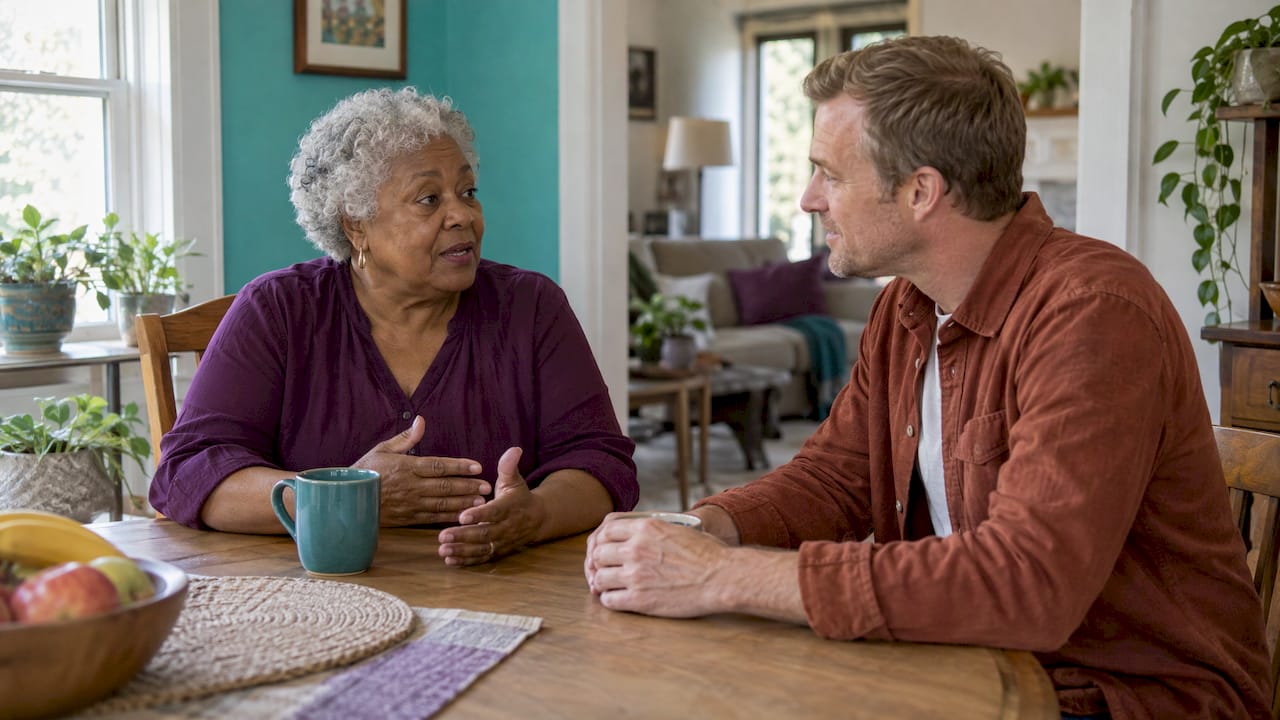
Open with their goals: staying in their own home, being able to travel, not being a burden. Then explain that a check-in is how they keep that independence, because it lets family worry less and intervene less. Present the choice as theirs. A parent who picked the app is far more likely to use it than one who was handed it.
Pick the check-in time and the question
Choose a moment that already exists in their day. Keep the prompt to one action. Our guide to one-tap daily check-in categories covers five categories you can set up quickly, and for families supporting someone with memory loss, the dementia caregiver check-in guide explains what to ask, what to watch and what to do.
Build a short, verified contact list
An alert is only as good as the person who receives it. Choose three to five people who will actually pick up, and confirm each has agreed. Our guides to building a verified emergency contact list and who to list as emergency contacts cover how to assign roles so that one missed alert does not mean a missed response. Well-Check lets the user create this network of emergency contacts directly in the app.
Write down the missed check-in plan
Decide in advance who calls first, who goes to the home if there is no answer, and when to involve emergency services or a neighbor. A written plan turns a stressful moment into a checklist. Our missed check-in protocol lays out that sequence step by step.
Add medication reminders if they help
Missed doses are one of the most common quiet risks for people who live alone. Reminders can be part of the same app, so the person has one tool, not three. See how to schedule medication reminders that seniors and caregivers can rely on, and medication adherence strategies that work at home.
Keep health information ready for emergencies
When a family member does reach the home or an emergency room, doctors will ask for medications, lab results and diagnoses. Keeping those documents organized in advance saves precious minutes. A digital option such as storing medical records in one place lets families gather prescriptions and reports so they are at hand when someone needs them.
Location sharing: where the line sits
Location is the feature families ask about most and the one that most affects dignity. A parent who still drives, walks or travels may welcome GPS as a safety net. Another may see it as tracking. The difference is consent and clarity.
Three habits keep location sharing respectful:
- Talk about what is shared, with whom and when.
- Use it for a purpose the person agrees with, such as finding them after a missed check-in, not for monitoring every outing.
- Review the settings together from time to time.
For background, read our explainers on how GPS tracking works, whether GPS tracking is safe and the privacy rules for senior GPS apps. If you want to know how precise a location reading is, see GPS accuracy outdoors and how often a location should update.
Fewer false alarms, fewer interruptions
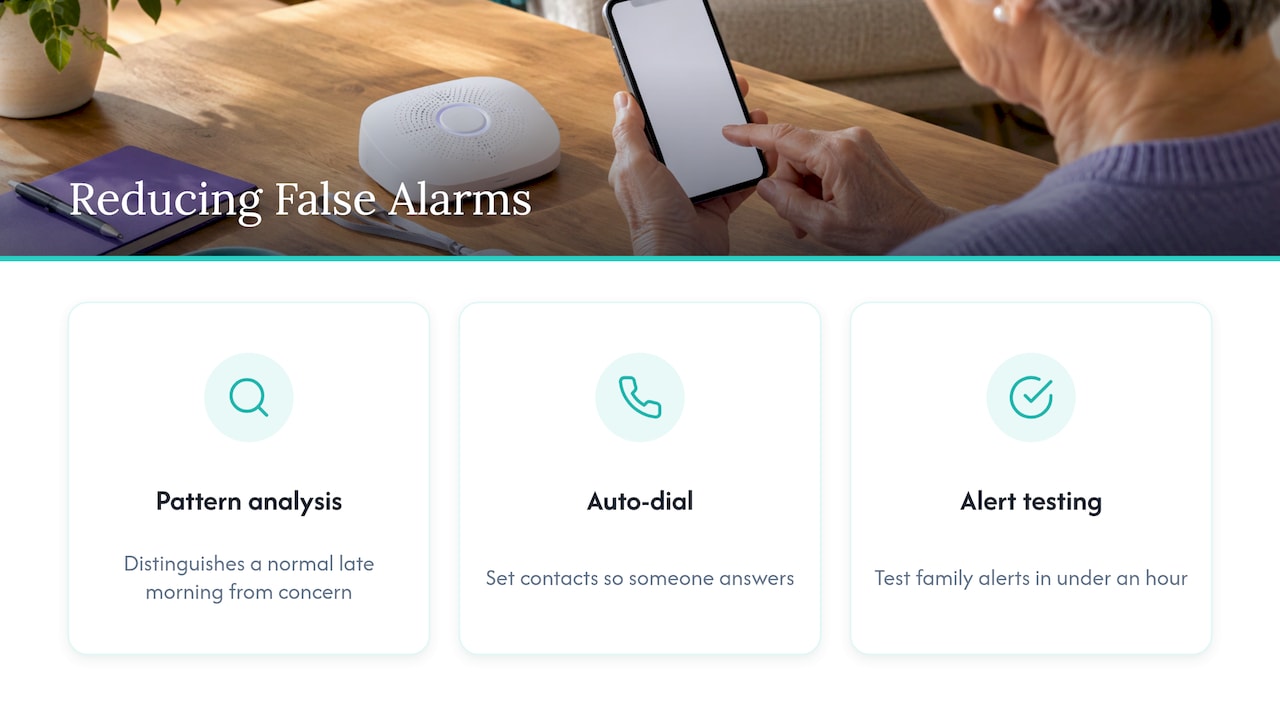
A system that cries wolf trains families to ignore it. Non-intrusive monitoring should be quiet most of the time and clear when it is not. Part of that is how the app reads patterns: Well-Check includes smart caregiver analysis, which helps caregivers make sense of check-in activity. Our guide to stopping false alarms with smart caregiver analysis explains how families use it to tell a normal late morning from a real concern.
Another part is the emergency routine. If the person prefers a phone to do the work, emergency auto-dial contacts can be set up so that someone answers. Family emergency alerts that put dignity first can be tested in under an hour, so you know they work before you need them.
A note on the other meaning of the term
If you arrived here from an engineering search: non-intrusive load monitoring estimates which appliances are running from a single meter per house or building rather than a sensor on each appliance. It is a method for energy research and building management, not a way to check on a family member.
What this looks like in a real week
Consider a hypothetical example. A retired teacher lives alone and her daughter lives two states away. They agree on a 9 a.m. check-in window. Most days, the teacher taps “I’m okay” with her tea. Her daughter sees nothing and thinks nothing. One Thursday no tap comes. The app alerts the daughter and the two neighbors on the contact list. One neighbor calls, gets no answer and checks the door. The point is that the family heard nothing for six days and exactly one alert on the day it mattered.
That ratio is the whole idea. A good system makes the ordinary days invisible, so the exceptional day is impossible to miss.
Who this approach fits
- Families of older parents who want peace of mind without calling every hour.
- Older adults who want to stay in their own home and keep control of their routine.
- Caregivers who juggle several responsibilities and need a dependable signal. Our guide to caregiver roles and responsibilities helps split the work among relatives.
- Busy professionals and college students who live alone and want a few trusted people to notice if they go quiet.
- Assisted living and retirement communities that want a simple check-in layer for residents. Well-Check offers plans for individuals, professionals and organizations.
Where to start
Well-Check has two plans, both published on our pricing page: Essential at $5.99 per month and Complete at $7.99 per month. You can download the app from the App Store or Google Play and set up the first check-in, the contact list and the reminders in one sitting.
If you are choosing for a parent, bring them into the setup. If you are choosing for yourself, pick the people you would want to hear from you. Either way, start with a plan for what happens on a missed check-in, and the technology will fit around it. See Well-Check plans to compare Essential and Complete.
Our perspective
Most families we think about are not looking for surveillance. They are looking for a reason to stop lying awake wondering whether Mom took her pills or Dad made it to the kitchen this morning.
We built Well-Check around simplicity and dignity. A single tap is enough to say “I’m okay.” Contacts are chosen by the person, and the app speaks up when a check-in is missed or help is requested. That is how we try to keep intrusion low and peace of mind high.
Our view is that independence and safety are not opposites. When older adults hold the controls, they keep using the tool, and when they keep using it, families get the early warning that matters. Medication reminders, GPS tracking and smart caregiver analysis then support that routine rather than replace it.
The best monitoring is the kind a person forgets is there until the day it counts.
Brian
FAQ
What is non-intrusive monitoring for seniors?
It is a way to confirm a person’s safety without cameras, constant tracking or frequent calls. The older adult checks in on their own terms, and family is alerted only when a check-in is missed or help is requested. The person’s consent and control are what make it non-intrusive.
Is a daily check-in app enough for someone living alone?
For many active older adults, a daily check-in plus a short emergency contact list and a written missed check-in plan covers the main gap: nobody noticing a problem. If a person has a serious medical condition or advancing memory loss, talk with their doctor about the level of support they need, and consider adding medication reminders and caregiver visits.
How do I bring this up with a parent who values privacy?
Start with what they want to protect: their home, their routine, their independence. Explain that a one-tap check-in lets family step back, and let them choose the time, the contacts and what is shared. Offering them the decision usually works better than presenting a finished plan.
What happens if a check-in is missed?
In Well-Check, a missed check-in triggers an alert to the emergency contacts the user set up. From there, your written plan applies: someone calls, then someone visits if there is no answer, and emergency services are called if there is any sign of danger.
Sources
- U.S. Census Bureau: Living Arrangements Varied Across Age Groups
- Social Isolation and Loneliness in Older Adults: A National Academies Report overview
- Approaches to Non-Intrusive Load Monitoring (SFU depth report)
- Non-Intrusive Load Monitoring Approaches for Disaggregated Energy Sensing (Sensors)