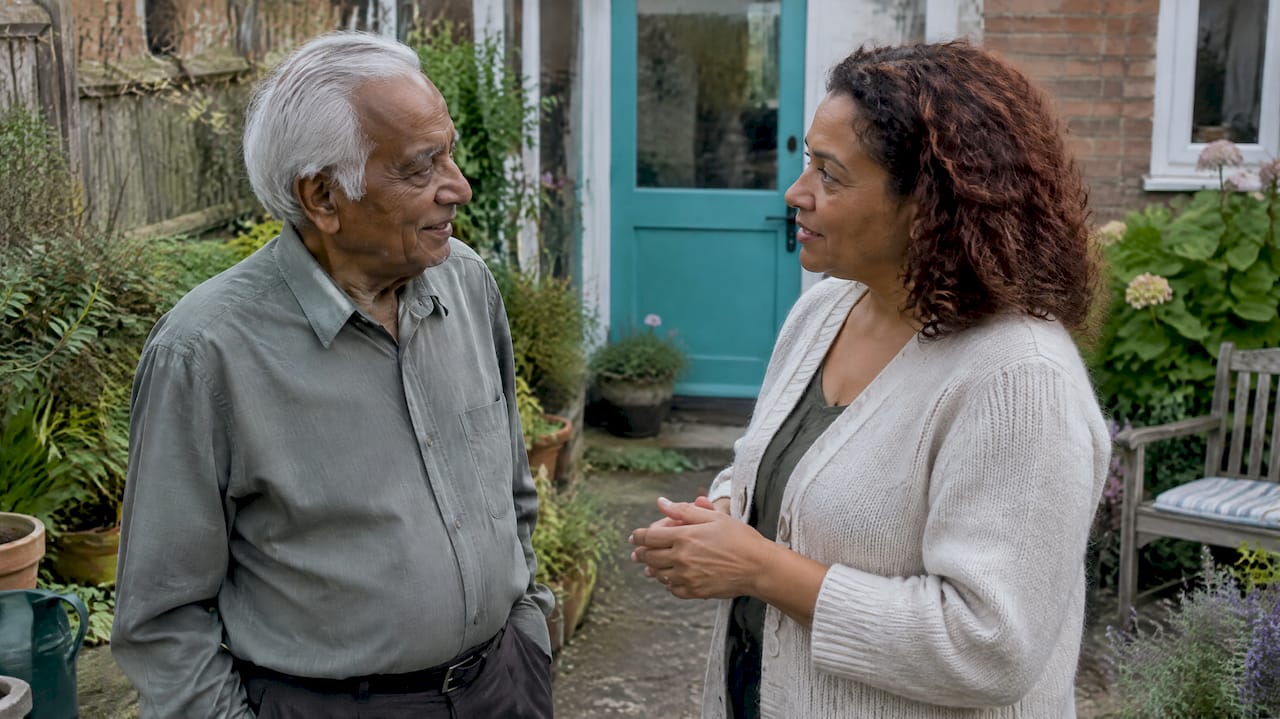
A good dementia caregiver check-in is short, predictable and focused on how the person seems, not only on what they say. Pick a consistent time, ask one or two easy questions, watch tone and body language, record what you notice, and agree in advance what happens if the check-in does not go through. The rest of this guide shows you how to build that routine, adjust it as needs change, and keep it respectful.
TL;DR
- Set one daily check-in time, keep it the same, and make the first question easy to answer.
- With dementia, feelings, tone of voice and actions tell you more than words do, so observe as much as you ask.
- Name one person who coordinates check-ins and agree how observations are shared with the rest of the family.
- Write a missed check-in plan before you need it: who calls, who visits, and when emergency services are the next step.
- Sudden changes in thinking, behavior or daily function call for a health care provider, not a wait-and-see approach.
Table of Contents
- What a dementia caregiver check-in actually is
- How to run the check-in itself
- What to track between check-ins
- How often should check-ins happen?
- Coordinating check-ins across the family
- What to do when a check-in is missed
- Keeping check-ins respectful
- When to call a doctor or emergency services
- Where an app fits
- Try a daily check-in routine with Well-Check
- FAQ
- Sources
What a dementia caregiver check-in actually is
A check-in is a planned, repeated moment of contact that answers one question: is this person safe and doing reasonably well right now? It can be a phone call, a video chat, a visit, a text exchange or a one-tap confirmation in an app. It is not an interrogation, a memory test or a performance review.
That distinction matters. Someone living with dementia often senses when they are being quizzed, and a check-in that feels like an exam can bring on defensiveness, embarrassment or withdrawal. The most reliable check-ins are warm, brief and boring in the best sense: the same time, the same opening, the same friendly tone.
There are really two layers:
- The contact itself. Did it happen, and did the person respond normally?
- The observation. What did you notice about mood, speech, alertness, surroundings and routine?
Most families only track the first layer. The second one is where early warning signs show up.
How to run the check-in itself
Keep the structure the same every day
For people in the early stage, the Alzheimer’s Association suggests setting a daily check-in time and using safety measures such as door alarms or monitoring devices to help maximize independence. A fixed time does two things. It becomes part of the person’s rhythm, so it is less likely to feel like an intrusion, and it gives everyone else a clear signal: if the check-in does not happen, something needs follow-up.
Choose a time when the person is usually at their best. Many people with dementia are sharper in the morning and more confused in the late afternoon, so a mid-morning call often goes better than an evening one. If you are not sure, try two or three times over a week and note which goes smoothly.
Start with something easy to say yes to
Open-ended questions such as “What did you do yesterday?” can feel like a trap when memory is failing. Try these instead:
- “Good morning. I’m just calling to say hello. How does your day look?”
- “Have you had your coffee yet?”
- “Is the sun coming in your window today?”
These invite a response without demanding recall. Follow the person’s lead. If they want to talk about something from decades ago, go with it. You are listening for the pattern of the conversation, not the accuracy of the facts.
Watch more than you listen
State guidance on dementia care advises caregivers to watch eyes and body language and to focus on feelings, tone of voice and actions rather than words, because communication abilities decline over time. In practice, that means:
- On a phone call, notice whether the voice sounds flat, rushed, frightened or unusually quiet compared with last week.
- On video, glance at the room behind them: is the lighting normal, is food visible, are the clothes appropriate for the weather?
- In person, notice posture, how they move through the room and whether they seem comfortable in their own space.
A person may say “I’m fine” in a voice that says otherwise. Trust the pattern you have learned over time.
Do not rely on self-report alone
Insight into one’s own condition can decline. The Alzheimer’s Association’s safety assessment tool advises consulting family or friends to verify what the person reports. So if your mother says she has taken her pills and eaten lunch, a neighbor’s glance at the pill organizer or a quick look at the fridge can confirm or correct the picture. This is not distrust. It is simply good information gathering.
What to track between check-ins
The point of observation is to notice change. A single odd afternoon means little. A shift that lasts days, or that arrives suddenly, means a great deal.
Michigan’s dementia care series includes a checklist that looks at sensory, comprehension and perception, executive, expressive and motoric functioning. You can turn those categories into plain-language prompts for a shared notebook or a note on your phone:
| Area | What to notice | Example of a change worth writing down |
|---|---|---|
| Senses | Seeing, hearing, reacting to sounds and light | Startles at ordinary noises, misses the phone ringing |
| Understanding | Following a simple conversation or instruction | Needs instructions repeated more often than last week |
| Planning and judgment | Handling tasks with several steps | Cannot finish making a sandwich or sort the mail |
| Speech | Finding words, staying on topic | New pauses, substituting wrong words, going silent |
| Movement | Walking, balance, handling objects | Dropping things, new unsteadiness, shuffling |
| Daily routine | Sleep, meals, medication, hygiene | Same clothes for days, spoiled food, skipped doses |
| Mood | Calm, anxious, suspicious, withdrawn | New fear, agitation at dusk, sudden apathy |
Keep entries to a line or two with the date. Over a month, the notes will show a trend that memory alone would blur, and they give a doctor something concrete.
Meals and the kitchen
Food is one of the clearest everyday signals. An empty fridge, expired items or the same snack every day often points to trouble with planning and shopping. Simplifying the kitchen can help, and so can meal planning without the stress when a family member is setting up a few easy options for someone living alone. Whatever method you choose, make the plan simple enough that the person can follow it on a bad day.

Medication
Missed or doubled doses are among the most common risks when someone lives alone. A medication reminder paired with the daily check-in gives you two chances to catch a problem. If you also use our guide to scheduling medication reminders, you can line the reminder up with the check-in time so the two reinforce each other.
How often should check-ins happen?
There is no single correct number, and the evidence is clear on why: the Alzheimer’s Association states that the frequency of assessment should be tailored to the individual and family situation.
It helps to separate two kinds of contact:
- Family or caregiver check-ins are the everyday touchpoints. For someone living alone with dementia, a daily one is a sensible baseline, and you can add a second on bad days or after a change in medication.
- Clinical reviews are done by health professionals. The same Alzheimer’s Association document recommends primary-care assessment at least every 6 to 12 months, and more often if behavior, cognition or function changes.
For a sense of what a formal service looks like, a UK National Health Service trust protocol for stable, non-complex patients specifies telephone reviews every 3 months and face-to-face reviews at least every 6 months. That is a clinical review schedule, not a replacement for daily family contact, but it shows how a stable situation is handled professionally and why anything less stable calls for more.
Letting the routine grow with the disease
A routine that works today may not in six months. Use these triggers to increase contact:
- A fall, illness, hospital stay or new medication
- A change in sleep, appetite or mood that lasts more than a few days
- A missed check-in that turned out to have a cause you did not expect
- The loss of a helper, such as a neighbor moving away or a paid aide leaving
A guide for professionals working with people who live alone with dementia notes that regular, small interactions can bridge the gap for those without informal support, and that involvement should not end without a plan for future check-ins. The same thinking applies to families: never let contact lapse without deciding what replaces it.
If you want a closer look at cadence, our article on check-in frequency for seniors explains when to add contact and when to automate it.
When the person can no longer take a call
Remote check-ins depend on the person being able to engage with them. The NHS trust protocol says that if someone living alone cannot take part in remote assessment because of advanced dementia, a face-to-face visit should be prioritized. If phone calls are becoming confusing or frightening, that is a signal to talk with the person’s doctor about whether living alone remains safe and what in-person support is needed.
Coordinating check-ins across the family
The most common failure in family care is not a lack of love. It is that everyone assumes someone else called. Guidance for people working with those who live alone with dementia says to identify a named person or service to check in or coordinate care and to agree how appropriate information will be shared.
A workable setup looks like this:
- One coordinator. This person holds the master notes, talks to the doctor and decides when to escalate.
- A rota for the rest. Siblings, friends and neighbors each take a day or a time slot so contact is spread out and nobody burns out.
- One shared place for notes. A group chat, shared document or app that everyone can see.
- A weekly summary. Five minutes on the phone or a short message: what changed, what worked, what is coming.
- Agreed privacy. Decide with the person, while they can still take part, who sees what. Medical details and location data should go only to the people who need them.
If your family is spread across states, our family meeting plan for long-distance caregiving takes 45 minutes and gets these decisions on paper. For dividing the work itself, see caregiver roles and responsibilities.
What to do when a check-in is missed
A missed check-in is not automatically an emergency, but it is never something to ignore with dementia. Decide the steps now, when everyone is calm, and write them down.
A simple escalation ladder:
- Try again within a few minutes, by a different route if you can: call, then text, then video.
- Contact the next person on the list. A nearby neighbor or friend may be able to knock on the door or look through a window.
- Go in person if nobody can confirm the person is fine, or send the person on your list who lives closest.
- Call emergency services if you have reason to believe the person is hurt, lost, or in danger, and give them the address and a description.
The VA’s safety checklist for dementia caregivers advises keeping emergency phone numbers and the home address near all phones and giving helpers contacts for family, caregivers and medical services. Put the same information on the fridge and in the coordinator’s phone so anyone stepping in has it at once.
Contingency planning goes further. The living-alone guide advises that you plan for backup because networks and services can stop for many reasons. Phone lines drop, batteries die and helpers get sick. Name a second person for every role.
For the detailed steps, our missed check-in protocol walks through each stage, and the caregiver emergency binder covers what to have ready for the first five minutes. If wandering is a concern, the safe return plan for dementia and our piece on preventing wandering are good next reads.
Keeping check-ins respectful
The goal is safety that does not strip away dignity. People who feel watched often resist help, hide problems or stop answering. People who feel respected keep the lines open.
- Involve the person. Ask what time and what method they prefer. A choice, even a small one, restores a sense of control.
- Be consistent, not constant. Frequent unscheduled calls feel like surveillance. A predictable one feels like a habit.
- Explain what happens next. “If I don’t hear from you by ten, I’ll ask Maria next door to wave hello” is kinder than a surprise knock.
- Match the tool to the stage. In the early stage, a reminder or a one-tap confirmation may be enough. Later, you will likely need a person on the phone or in the room.
- Share location only with consent where possible, and be clear about why. Our guide to GPS tracking, privacy and consent covers how to approach that conversation.
When to call a doctor or emergency services
Check-in notes are most valuable when they change what you do. The Alzheimer’s Association’s practice recommendations say that sudden or unexpected declines in cognition or function warrant referral to a health care provider, and that behavior changes call for investigation and a comprehensive health assessment.
In practice:
- Call the person’s doctor promptly about new confusion that arrives over hours or days, new agitation or hallucinations, loss of appetite, unusual sleepiness, a fall, or a sharp change in how they handle everyday tasks. Sudden change can have treatable causes such as infections or medication effects, and only a clinician can sort that out.
- Call 911 when you believe there is immediate danger: an injury, a medical emergency, a person who is missing, or someone who cannot be reached and may be hurt.
- Bring your notes to the appointment. Dated observations help a clinician far more than “she’s been off lately.”
You are not diagnosing. You are the person who notices.
Where an app fits
Technology cannot replace a human who cares, but it can take care of the part that people forget: the reliable, on-time prompt, and the fast alert when something is off. For someone in the early stage who wants to live independently, an app can carry the daily routine so the family does not have to chase it.
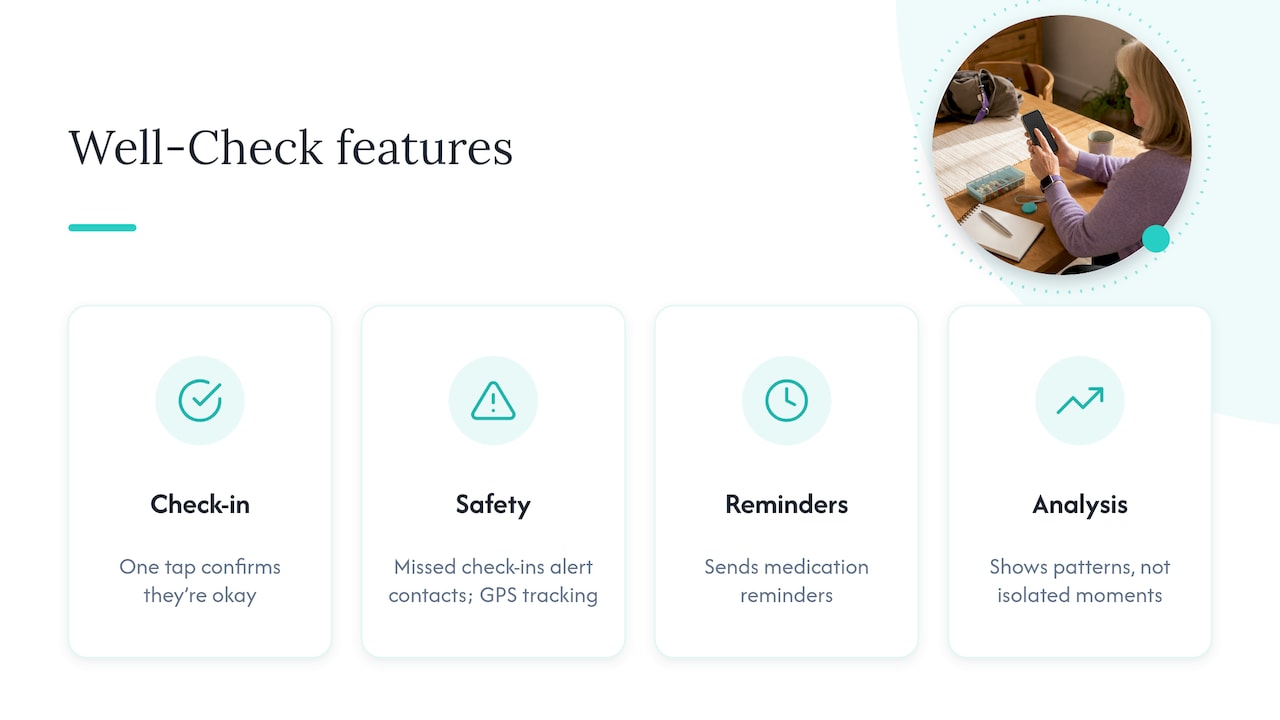
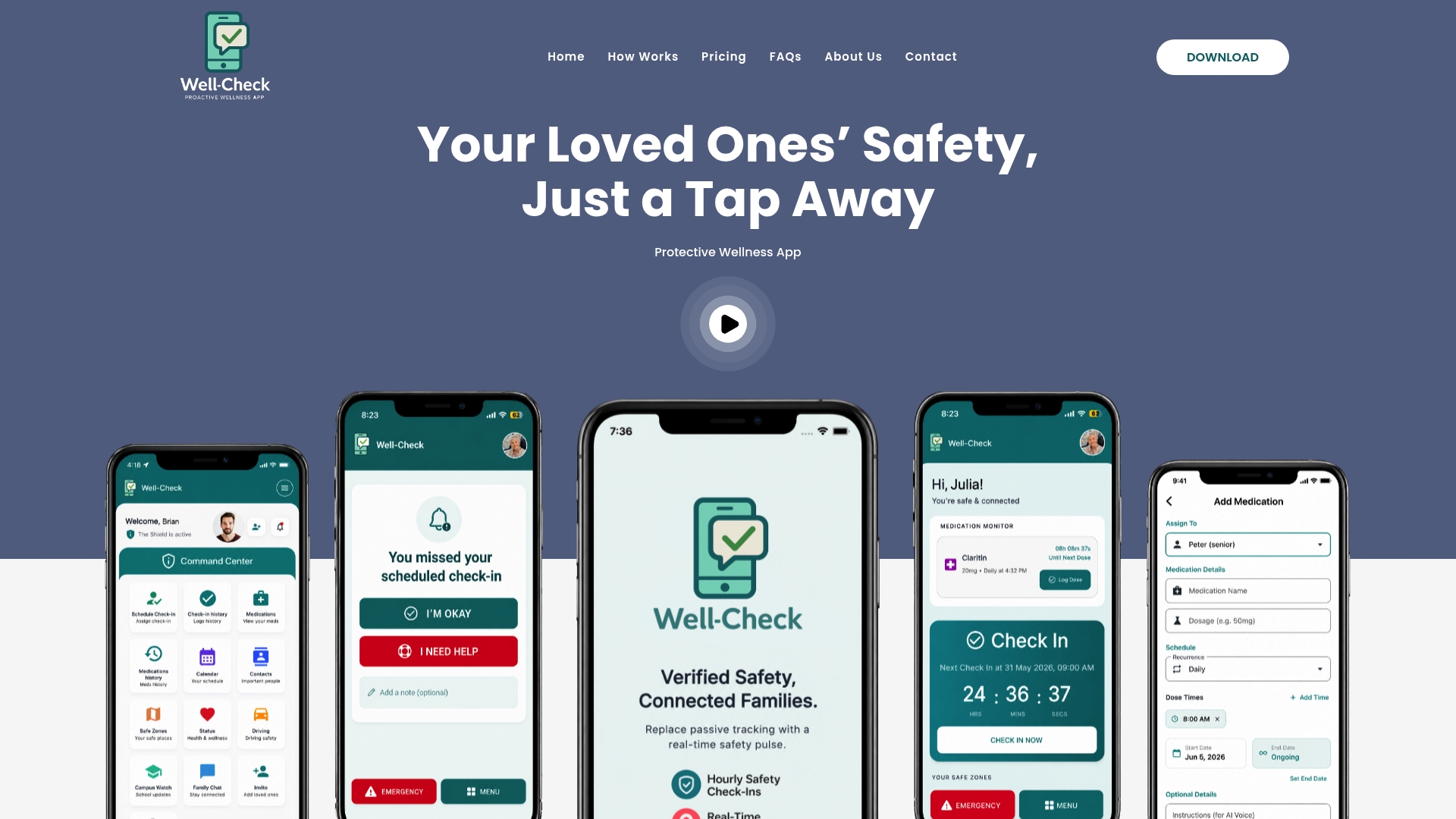
Well-Check is built around that idea. The person taps once to confirm they are okay, and if a check-in is missed, the people on their emergency contact network are alerted. It also sends medication reminders, includes GPS tracking, and offers smart caregiver analysis so families can see patterns instead of isolated moments. We designed it for simplicity and dignity: independence without surveillance.
Perspective
We built Well-Check because the hardest part of caring from a distance is not the big emergency. It is the quiet uncertainty of an ordinary Tuesday, when you wonder whether your parent is okay and cannot tell without making a call that might feel like an intrusion.
Our view is that a check-in should be small, predictable and respectful. One tap that says “I’m okay” asks very little of the person, and it gives the family a clear signal. When the signal does not arrive, the app alerts the contact network so the family acts quickly rather than waiting and worrying.
We also believe that features like medication reminders, location and caregiver analysis only earn their place if they protect independence rather than erode it. That is why we design around the person first: the simplest possible interface, a network they choose, and routines they can recognize. A good tool lets a family step back a little because they trust the safety net is there.
Brian
Try a daily check-in routine with Well-Check
If you want a check-in routine that runs on its own and tells the right people when it breaks, Well-Check offers two plans: Essential at $5.99 per month and Complete at $7.99 per month. You can compare what each includes on our pricing plans page, or read more about our app for older adults.
If you are still building your safety plan, start with our senior safety checklist and our guide to building a verified emergency contact list. Both can be done in one sitting.
FAQ
How often should I check in on a parent with dementia who lives alone?
Daily contact at a consistent time is a sensible baseline, and the Alzheimer’s Association says frequency should be tailored to the person and family. Add contact after a fall, an illness, a medication change or any new behavior. Ask the person’s doctor whether living alone is still safe as the disease progresses.
What should I say during a dementia check-in call?
Keep it warm and easy: a greeting, a simple question about the day or a familiar topic, and a friendly sign-off. Avoid quizzing about what they did or remember. Listen for tone, pace and mood, which tell you more than the words do.
What should I do if my loved one does not answer a check-in?
Try again by another route, then contact the next person on your emergency list, such as a nearby neighbor or relative. If nobody can confirm they are fine, go in person. Call 911 if you think they are hurt, missing or in danger.
Can a check-in app replace visits from family?
No. An app handles the routine prompt and the alert, but it does not see how someone looks, how the home is, or how they are really doing. Use it to make visits and calls more meaningful, and prioritize in-person visits as dementia advances.
How do I make check-ins feel less intrusive?
Involve the person in choosing the time and method, keep the routine predictable, and explain what happens if they miss a check-in. Share location and health information only with people who need it, and be open about why.
Sources
- Basic Dementia Care Guide, Oklahoma State Department of Health
- Safety Assessment Checklist, Alzheimer’s Association
- Wandering, Alzheimer’s Association
- Dementia Care Practice Recommendations: Person-Centered Assessment and Care Planning, Alzheimer’s Association
- Dementia Care Series, Caring Sheet 21, Michigan Department of Health and Human Services
- Caring for Dementia: Safety Checklists, Veterans Affairs
- Living Alone with Dementia guide
- CHDS Operational Protocol, East London NHS Foundation Trust
- How to meal plan without really meal planning

[…] memory loss is part of the picture, our guide to a dementia caregiver check-in covers what to ask, watch and […]