
In psychology, compliance means going along with a request even when you do not fully agree with it. Adherence means following a plan you have agreed to and understand. For a daily check-in with an older parent, that difference decides whether the routine lasts. A check-in built on pressure produces a tap on a screen for a few weeks. A check-in built on agreement becomes a habit. Well-Check is designed around the second kind: one-tap check-ins, a contact network the senior helps shape, and as little intrusion as possible.
TL;DR
- Compliance is going along with a request, often without agreeing. Adherence is following a plan you helped make. Health research prefers the second idea.
- Public pressure, authority and clever request tactics can produce compliance, but they do not build a lasting habit.
- Research on medication adherence points to the same drivers a check-in routine needs: agreement, simplicity, social support and good communication.
- Set up a check-in together, keep it to one tap, and agree in advance on who is alerted and when.
- Well-Check’s Essential plan is $5.99 per month and Complete is $7.99 per month.
Table of Contents
- What compliance means in psychology
- Compliance, conformity and obedience
- Adherence: the word health care prefers
- What makes people say yes
- Why daily check-ins fade when they feel like compliance
- Building a check-in routine your parent will keep
- Who this matters for
- Try the routine with Well-Check
- FAQ
- Sources
What compliance means in psychology
The APA Dictionary of Psychology gives two meanings: submission to the demands, wishes or suggestions of others, and a change in behavior in response to a direct request. It adds that in drug treatment, compliance is now often described as adherence.
The OpenStax Psychology 2e textbook puts it in plain terms: compliance is going along with a request or demand even if you do not agree with it. In Asch’s well-known line-length experiments, many participants gave a wrong answer out loud because the group did, while privately knowing it was wrong. They complied in public and did not accept it in private.
Now picture a daughter who texts her father every morning, “Did you take your pills? Are you up?” He answers with a thumbs-up to end the conversation. That is compliance. The behavior appears, but the agreement behind it may not. Once the daughter is busy, or the father feels watched, the thumbs-up stops.
Compliance, conformity and obedience
These three words get mixed up, and each one points to a different pressure.
| Term | What changes behavior | Everyday example |
|---|---|---|
| Conformity | The group | A resident joins the activity everyone else attends |
| Compliance | A direct request | A parent taps “I’m okay” because a child asked |
| Obedience | An authority figure | A patient follows a clinician’s instruction out of fear of consequences |
OpenStax defines obedience as changing behavior to follow a demand from an authority figure, and notes that people often obey because they worry about what happens if they do not. Conformity, in the same chapter, is changing behavior to go along with the group. In Asch’s 1955 study, 76% of participants conformed at least once.
A family check-in sits between compliance and obedience. The adult child is not an authority in the formal sense, but the older adult may feel the request carries weight, especially after a fall or a hospital stay. That is why the tone of the request matters as much as its content.
Adherence: the word health care prefers
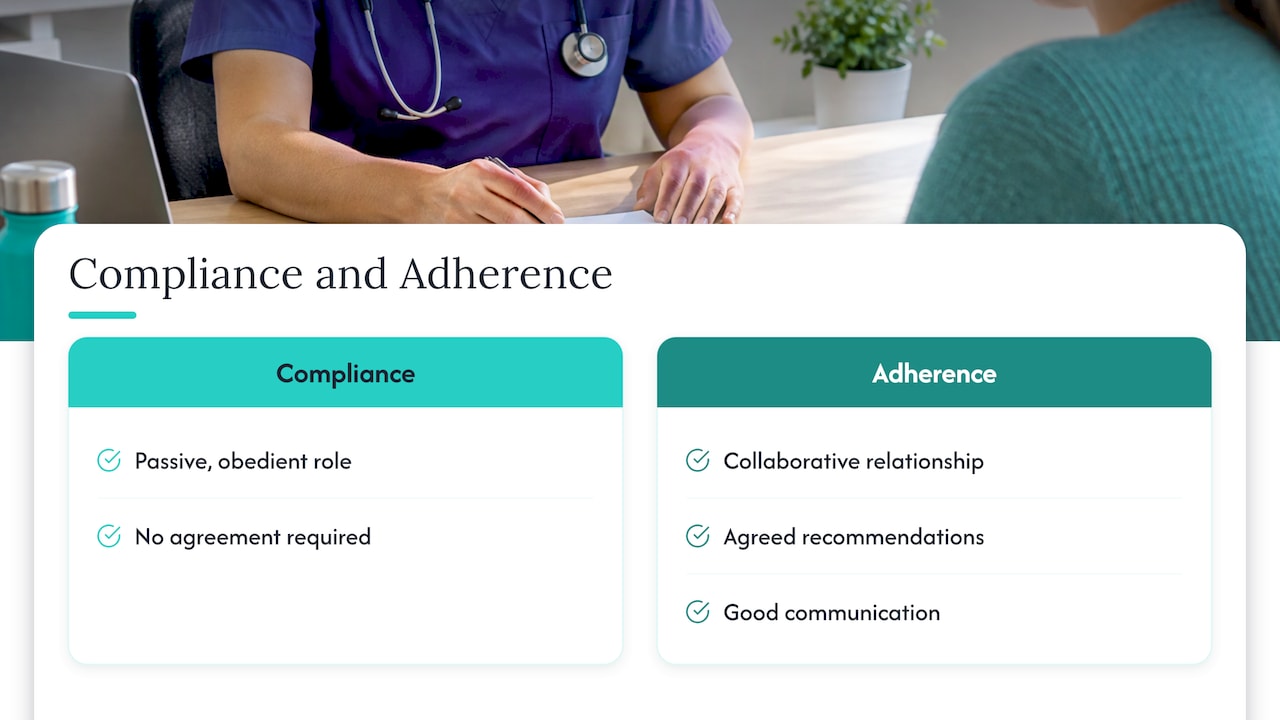
Clinicians moved from “compliance” to “adherence” because the first word describes a passive patient. One review in Papeles del Psicólogo describes adherence as a collaborative relationship between patient and practitioner, while compliance implies a passive, obedient role. A journal article on maximizing patient adherence makes the same point: adherence is behavior that matches agreed recommendations, and unlike compliance it requires the patient’s agreement and rests on good communication.
The Texas Pharmacy Association adds a third idea, persistence: how long someone keeps going from the start of a routine until they stop. For check-ins, persistence is the real goal. A routine that works for two weeks and dies in the third has not helped anyone.
The same distinction appears in home care. The difference between reminding someone to take their medication and doing it for them is a question of who stays in charge, and medication prompting versus administration shows how care providers separate the two. A check-in app belongs on the prompting side: it supports a person who is running their own day.
Agreement also depends on trust. When people feel heard by the professionals around them, they are more likely to follow a plan, which is why personalized mental health treatment stresses fitting care to a person’s own goals. The same logic applies at home: a routine designed around your parent’s goals is one they will keep.
How big is the adherence gap?
A peer-reviewed review by Stonerock and Blumenthal reports estimates that up to 40% of patients in general medical populations do not adequately follow physician instructions, rising to 70% or more when significant lifestyle change or complex behavior is required. In the Papeles del Psicólogo review, the APA’s international consensus counts patients who take more than 80% of their medication as adherent. Those figures describe medical care, not check-ins, but they show how hard it is to keep any daily behavior going, and why design matters.
What makes people say yes
Psychologists have studied for decades what pushes people to comply. Knowing the mechanisms helps you avoid the ones that backfire in a family routine.
Public versus private responses
OpenStax, drawing on Deutsch and Gerard’s 1955 work, notes that people conform more when responses are public than when they are private. A check-in that is visible to a whole family group chat can feel like a performance. A private tap that reaches only the people the senior chose feels more like a decision.
Group size and one dissenter
In Asch’s 1955 study, conformity rose as the group grew up to seven people, then leveled off. One dissenter dropped conformity to near zero. For families, the lesson is practical: a small contact network, where one person can say “Mom is fine, let her do this her way,” is calmer than a crowd of relatives each sending their own reminders.
Sequential request tactics
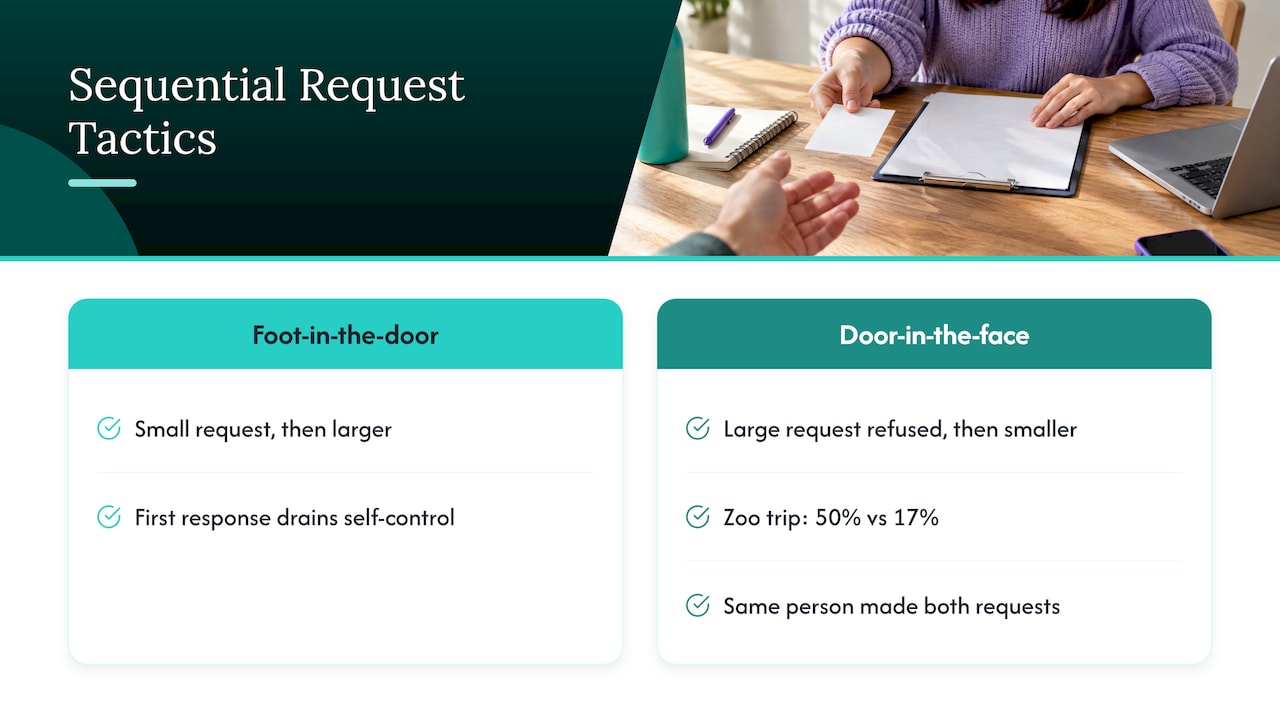
Two classic techniques show how compliance can be engineered. In foot-in-the-door, someone agrees to a small request and then a larger one. A peer-reviewed study by Fennis and Janssen found that actively answering the first request drains self-regulatory resources, and that this depletion explains the effect on the second request.
In door-in-the-face, a large request is refused and a smaller one follows. The same study describes a 1975 demonstration where half of students who had refused to volunteer long-term agreed to take juveniles on a two-hour zoo trip, against 17% of those asked only the zoo request. It worked only when the same person made both requests, which fits the norm of reciprocity.
A 1998 meta-analysis by O’Keefe and Hale found the average door-in-the-face effect small (r = .10) and variable, and suggested guilt over refusing the first request may play a role. Guilt is a shaky foundation for a daily routine. It can get a yes today and leave resentment behind.
Tired people say yes more easily
Research by Vohs and colleagues across six experiments found that weak self-control makes people more likely to comply with charitable requests, because they lean on shortcuts such as reciprocity, liking and consistency. An older adult who is tired, unwell or overwhelmed may say yes to a check-in plan during a stressful week. That is compliance, not buy-in, so revisit the plan once things are calm.
Why daily check-ins fade when they feel like compliance
Most check-in routines fail for ordinary reasons, and the research on adherence names them.
- Complexity. The Wiley review lists the complexity of the protocol among the factors that affect adherence. A check-in that needs three screens and a password asks too much.
- Weak alliance. The Papeles del Psicólogo review lists a weak therapeutic alliance, lack of social support and stigma among the factors linked to poor adherence. If the senior feels the routine is about distrust, stigma is already in the room.
- Cognitive load. The same review lists memory and attention problems. For a parent with early memory changes, the cue, not the willpower, has to do the work.
- Mood and literacy. Stonerock and Blumenthal report that lower health literacy and significant depressive symptoms are associated with poorer adherence. A caregiver who notices a parent withdrawing from the routine may be seeing low mood, not stubbornness.
- Cost and side effects. Patients often cite them when deciding to stop a medication, according to the same article. For a check-in subscription, the equivalent is a price the family finds hard to justify.
None of this means seniors resist safety measures. It means a routine has to earn its place in a person’s day.
Building a check-in routine your parent will keep
Treat the setup as a conversation, not an announcement.
- Start with the reason, in their terms. Ask what independence means to your parent. Many people accept a routine that protects living at home more readily than one described as “for your safety.” The point is agreement. Our guide to using a check-in app as a safety net, not surveillance covers how to frame this.
- Make the action tiny. One tap that says “I’m okay” removes most of the friction. Well-Check is built around one-tap check-ins and “I’m okay” confirmations, and its design aims to keep the daily action short.
- Choose the time together. Anchor the check-in to something that already happens, like morning coffee. Advanced scheduling lets the family set times around the person’s day. If you are unsure how often to ask, see how to set check-in frequency for seniors.
- Pick the contact network with your parent. The Asch findings suggest a small group beats a large one. A list of three to five trusted people is easier to manage, as our guide to building a verified emergency contact list explains.
- Agree what a missed check-in means. Missed check-in alerts go to the family members on the contact list. Decide beforehand who calls first and how long to wait, so a late tap does not become a family panic. The missed check-in protocol walks through the steps.
- Connect medication reminders to the same habit. Reminders belong in the same routine, so the senior is prompted without being managed. See medication adherence strategies that work at home and how to schedule medication reminders.
- Put the rules on paper. A short written agreement about who sees what, and when, protects trust. A family monitoring agreement gives you a fillable plan.
- Review it after a few weeks. Ask what feels useful and what feels intrusive. Adjusting the plan together is what turns compliance into adherence.
If your parent lives with memory loss, the questions change and a caregiver takes a larger role. The dementia caregiver check-in guide covers what to ask, watch and do.
Language that invites agreement
Small wording choices shift a request from demand to invitation. “I’d like to know you’re okay” is easier to accept than “You have to check in.” Offering two options, such as morning or evening, gives the person a say. Thanking them for the tap, not scolding a late one, keeps the routine pleasant. Avoid stacking requests, because the foot-in-the-door research suggests that a chain of small agreements can leave people worn out and quietly resentful.
Who this matters for
The psychology is the same across the people who use check-ins. An older adult wants independence. A busy professional living alone wants a safety net they do not have to think about. A college student wants a network of friends who notice if something is wrong. In each case, the person being checked on stays in control of the routine, and the people who care about them get a clear signal. Organizations such as assisted living communities and retirement homes face the same question at scale: a routine residents agree with lasts longer than one imposed on them.
Our perspective
We built Well-Check on a simple belief: safety that feels like surveillance will not last. The research on compliance and adherence says the same thing in academic language. People keep doing what they understand, choose and can do easily.
That is why the app is designed for simplicity and dignity. The daily action is one tap. The contact network is customizable, so the person being checked on helps decide who is in it. Missed check-in alerts reach family only when the routine is broken, so everyone else can get on with their day.
We also think peace of mind should run both ways. The senior keeps independence, and the family stops wondering. Features like medication reminders, GPS and smart caregiver analysis are there to support a person’s own routine, not to replace their judgment.
If you take one thing from the psychology, let it be this: ask first, keep it light and revisit the plan together.
Brian
Try the routine with Well-Check
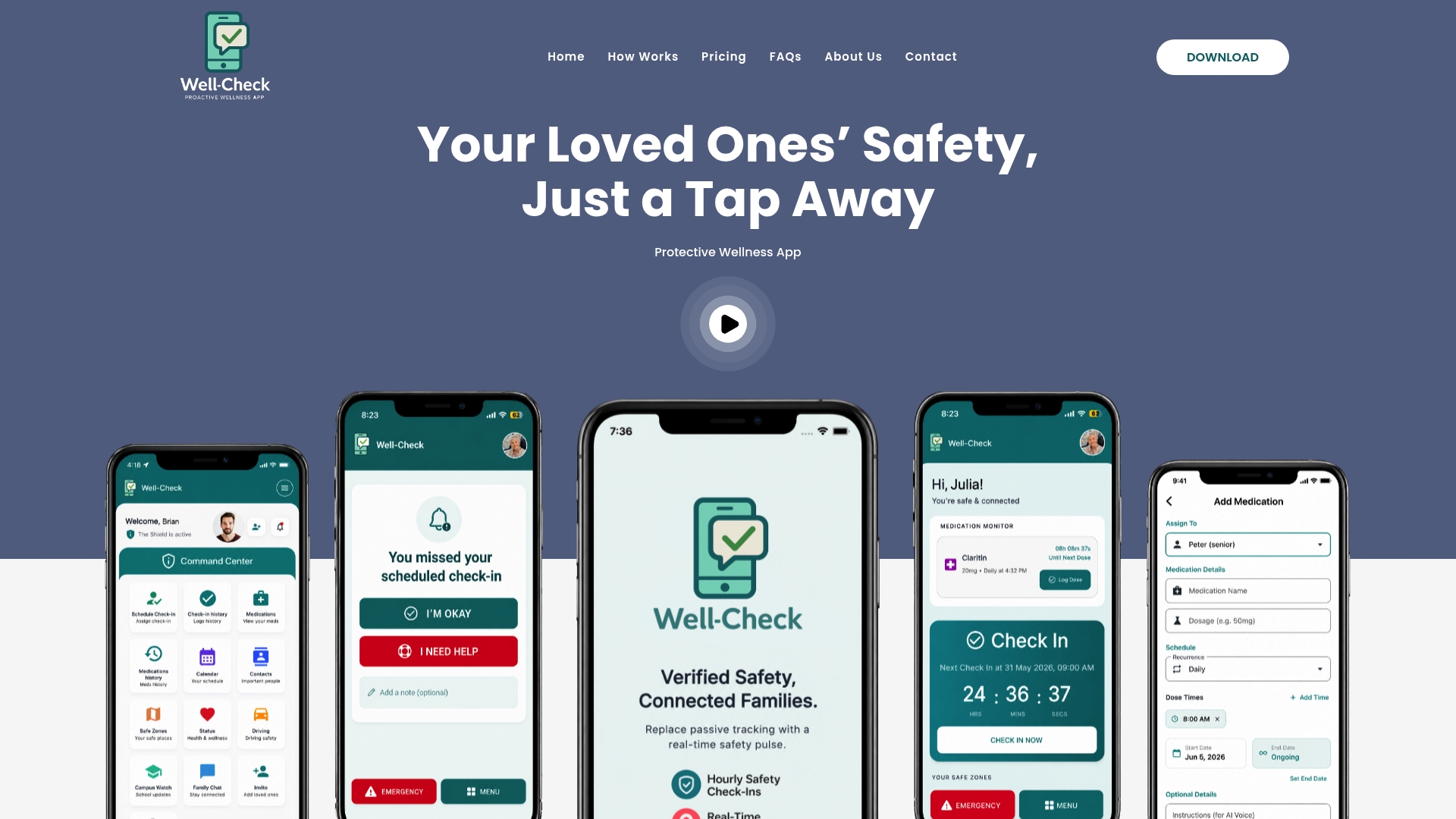
Well-Check gives families a daily check-in, medication reminders, missed check-in alerts to an emergency contact network, GPS tracking and smart caregiver analysis in one app. Essential is $5.99 per month and Complete is $7.99 per month. You can compare both on the Well-Check pricing page.
If you want a plan to go with the app, the senior safety checklist lets caregivers set things up in one sitting.
FAQ
What is the difference between compliance and adherence?
Compliance means following a request or instruction, often passively and sometimes without agreeing. Adherence means behavior that matches a plan the person has agreed to, built on good communication. Health professionals prefer adherence because it treats the patient as a partner.
What is an example of compliance with a daily check-in?
A father taps a reply to his daughter’s text each morning only to stop the nagging, and he privately finds it annoying. The behavior is there, but the agreement is not. If the routine changes or the pressure eases, the habit is likely to stop.
Why do some seniors resist check-ins?
Common reasons include feeling watched, stigma about needing help, a routine that is too complicated, low mood, or memory problems. Research on medication adherence links all of these to poorer follow-through. Asking what the person wants, keeping the action to one tap and agreeing on who is alerted tends to help.
Do compliance techniques like foot-in-the-door work on family members?
They can produce a quick yes, but the effects are modest and depend on the situation. A 1998 meta-analysis found the average door-in-the-face effect small. Guilt or fatigue may drive the yes, which is a weak basis for a routine that has to last months. Open agreement is a better foundation.
How much does Well-Check cost?
The Essential plan is $5.99 per month and the Complete plan is $7.99 per month, as published on the Well-Check pricing page.
Sources
- APA Dictionary of Psychology: compliance
- OpenStax Psychology 2e: Conformity, Compliance, and Obedience
- Maximizing patient adherence for optimal outcomes
- Interventions to improve therapeutic adherence, Papeles del Psicólogo
- Improving Patient Adherence, Texas Pharmacy Association
- Role of counseling to promote adherence, Stonerock and Blumenthal
- Mindlessness Revisited: Sequential Request Techniques, Fennis and Janssen
- The Door-in-the-Face Influence Strategy, O’Keefe and Hale
- Acts of Benevolence: A Limited-Resource Account of Compliance, Vohs et al.