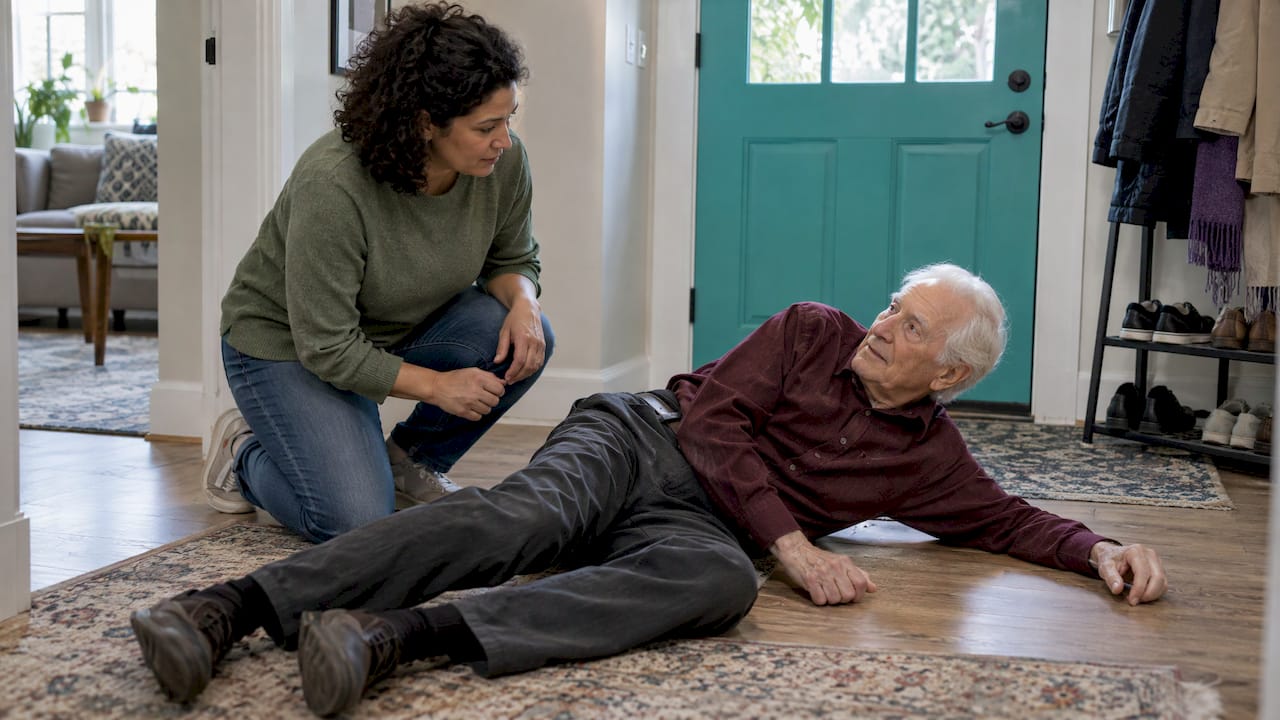
After a fall, do not rush to pull the person up. Check for injury first, call 911 for head, neck, back or hip injuries, or if they cannot get up. Then plan the next 48 hours: watch for delayed symptoms, tell a doctor about the fall, and make sure help can reach an older adult who lives alone. This plan covers all of it. A daily check-in app like Well-Check is part of the plan, because it means a missed check-in alerts the people you chose.
TL;DR
- Stay still or keep the person still, and check for breathing, bleeding, loss of consciousness, confusion and pain before any attempt to stand.
- Call 911 for a head, neck, back or hip injury, trouble breathing, confusion, weakness on one side, slurred speech, or if the person cannot get up. Blood thinners raise the stakes even when nothing looks wrong.
- Over the next 48 hours, watch for new symptoms, such as worsening headache, drowsiness, vomiting or confusion.
- Every fall is worth a call to the doctor, even without injury, because it can point to a problem that can be treated, such as a medication side effect.
- If you live alone, set up a way to be found quickly: a phone you can reach, a contact list and a daily check-in that alerts family when you miss one.
Table of Contents
- The first minutes: check before you move anyone
- When to call 911
- If you cannot get up and no one is there
- The next 48 hours: what to watch for
- Call the doctor even if nothing hurts
- Medications: a fall plan is also a medication plan
- Preventing the next fall
- Making sure someone notices
- Perspective
- How Well-Check fits the plan
- Your printable action plan
- FAQ
- Sources
The first minutes: check before you move anyone
The most common mistake is helping too fast. U.S. Department of Veterans Affairs guidance says to check for injury and not get the person up until you are certain there is no serious injury. It also says not to lift a fallen person by yourself and to call for help.
If you are the person who fell, the advice is the same: stop, catch your breath and take stock. The Public Health Agency of Canada advises you to check whether you are injured even if you think you are fine, and to take your time before getting up.
If you are helping someone else
Work through these questions in order, calmly and out loud so the person can answer:
- Are they breathing? If not, call 911 right away.
- Are they bleeding? Apply pressure and call for help.
- Did they lose consciousness, even briefly, or are they more confused than usual?
- Where does it hurt? Pay particular attention to the head, neck, back and hip.
These are the checks the VA guidance lists. Keep the person warm and comfortable while you wait for help. Do not give food or drink if you suspect a serious injury.
If you are the one on the floor
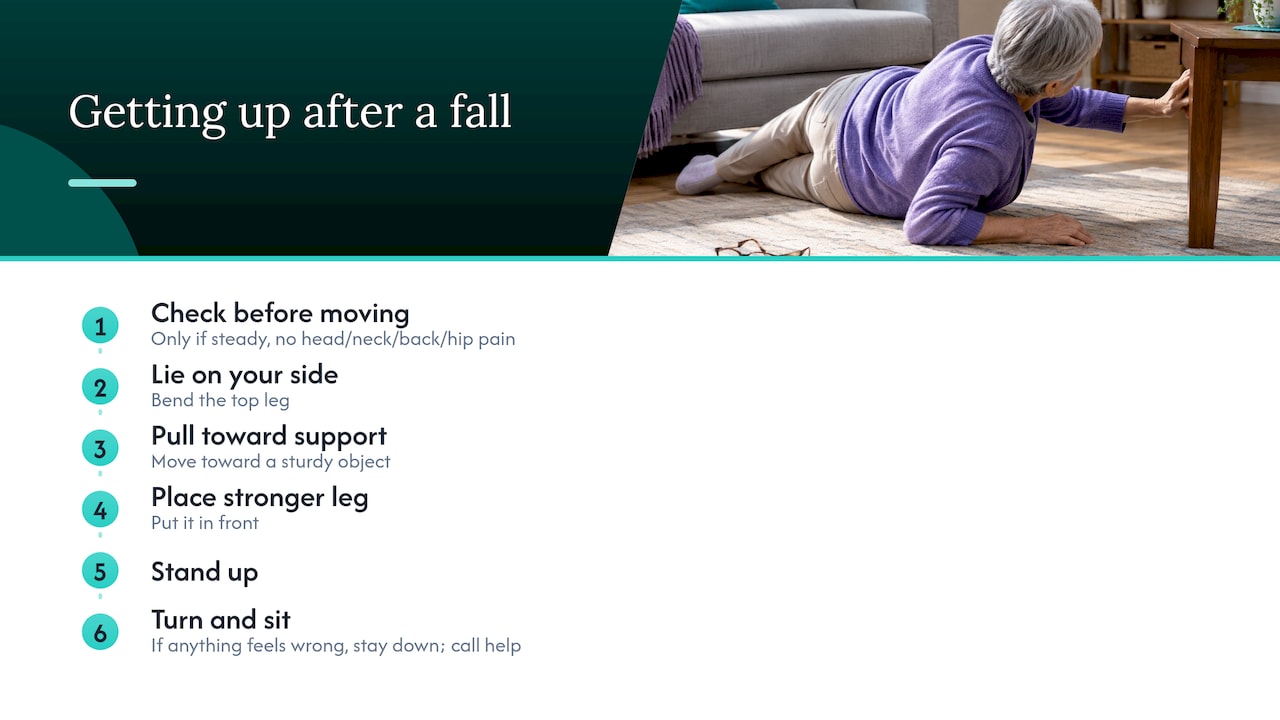
If nothing seems seriously hurt, Canada’s guidance gives five steps for getting up: lie on your side and bend the top leg, pull yourself toward a sturdy object, place your stronger leg in front, stand up, then turn carefully and sit down. Use it only when you have no pain in the head, neck, back or hip and you feel steady. If anything feels wrong, stay down and call for help.
When to call 911
Treat these as emergencies. Do not wait to see whether they pass.
- Head, back, neck or hip injury, or being unable to get up. The UK’s NHS says to call emergency services if someone who has fallen may have injured their head, back, neck or hip, or cannot get up.
- Serious head injury signs. Mayo Clinic lists serious head or facial bleeding, fluid or blood from the nose or ears, a change in consciousness lasting more than a few seconds, worsening confusion, loss of balance, weakness in an arm or leg, one pupil larger than the other, slurred speech and seizures as reasons to call 911.
- Stroke or heart warning signs. ECU Health advises calling 911 for trouble breathing, fainting, a fast or very slow heart rate, trouble with speech or vision, numbness or weakness on one side, or facial droop.
Blood thinners change the rule
If the person takes an anticoagulant, treat any fall as a reason for the hospital. Cleveland Clinic says you should always go to the hospital after a fall if you take blood thinners, because internal bleeding can happen without a visible injury, especially after a hit to the head, chest, back or abdomen. A UK decision tool for post-fall care also lists new central neck or back pain, blood or clear fluid from an ear, bruising around an eye or behind an ear, repeated vomiting, and a fall from a height of one metre or five steps as signs needing urgent attention.
Keep a current medication list where you or a responder can find it. It saves time when every minute counts.
Urgent but not 911
Contact the doctor right away for repeated falls, dizziness, a severe headache, or blood in vomit or stools, as ECU Health recommends. If you are unsure which category a symptom falls into, call 911 and let the dispatcher decide.
If you cannot get up and no one is there
A fall is far more dangerous when the person lies there for hours. For someone living alone, the plan has to work without a bystander.
The NHS advises that if you cannot get up, use a phone or personal alarm, or shout or bang on a wall or floor to get help. While you wait, keep warm and try to change position about every 30 minutes. The Canadian guidance adds practical details: slide toward a telephone or a place where you will be heard, make noise with a cane or another object, put a pillow under your head, cover yourself with clothing or a blanket, and move your joints gently to ease circulation and stiffness.
Two habits make this realistic:
- Carry the phone. A phone left on the kitchen counter does nothing when you are on the bathroom floor. A phone in a pocket does.
- Keep a list near the phone. The VA guidance suggests keeping a list of friends, neighbors, church members and emergency numbers near your phone. Our guide to building a verified emergency contact list of three to five people shows who to include and how to make sure they will pick up.
The next 48 hours: what to watch for
A person who seems fine right after a fall can develop symptoms later, especially after a head strike. Caregivers in care settings follow structured observation schedules, and family caregivers can borrow the logic.
The ECRI post-fall checklist says to record vital signs and neurological observations every 30 to 60 minutes for four hours after a fall. For unwitnessed falls, falls with a head strike, or falls involving anticoagulant or antiplatelet medication, it continues observations hourly from 6 to 12 hours and every four hours from 12 to 48 hours if the person is stable. Those schedules are written for clinical staff, so at home treat them as a reason to stay close, not as a protocol to run yourself. Ask the doctor or nurse what to watch for in your situation.
The signs to report are the same ones care teams escalate. The ECRI checklist and Western Australia’s post-fall guidelines both say to notify a physician of visual changes, speech disturbance, or new weakness or numbness. Add what Cleveland Clinic names as delayed head-injury symptoms: confusion, drowsiness or behavior changes.
A simple home watch sheet
Write down, with times:
- When and where the fall happened, and whether anyone saw it
- Whether the head was hit
- Pain locations
- Any new confusion, sleepiness, vomiting, headache, vision or speech change
- Medications taken that day, especially blood thinners
Hand this sheet to the doctor or the emergency crew. Memory is unreliable after a fall, and the AAFP journal notes that a patient’s history may be inaccurate in someone with cognitive impairment. A written record from someone else helps.
Call the doctor even if nothing hurts
A fall with no injury still matters. AARP quotes a geriatrics physician explaining that falling once doubles your chances of falling again, according to the CDC, so even a fall with only minor scrapes deserves a conversation with your doctor. The VA guidance likewise says all falls should be treated as serious and that a fall can be a symptom of a larger problem.
The visit is where the cause gets found. The AAFP article says the steps after addressing injuries are to identify the cause and reduce future risk: review the home, manage chronic conditions such as diabetes, hypertension, osteoporosis and depression, avoid unnecessary medications that raise fall risk, and optimize vision, hearing, foot care and walking aids. The same article reports that falls occur in more than 27% of U.S. adults 65 and older.
Medications: a fall plan is also a medication plan
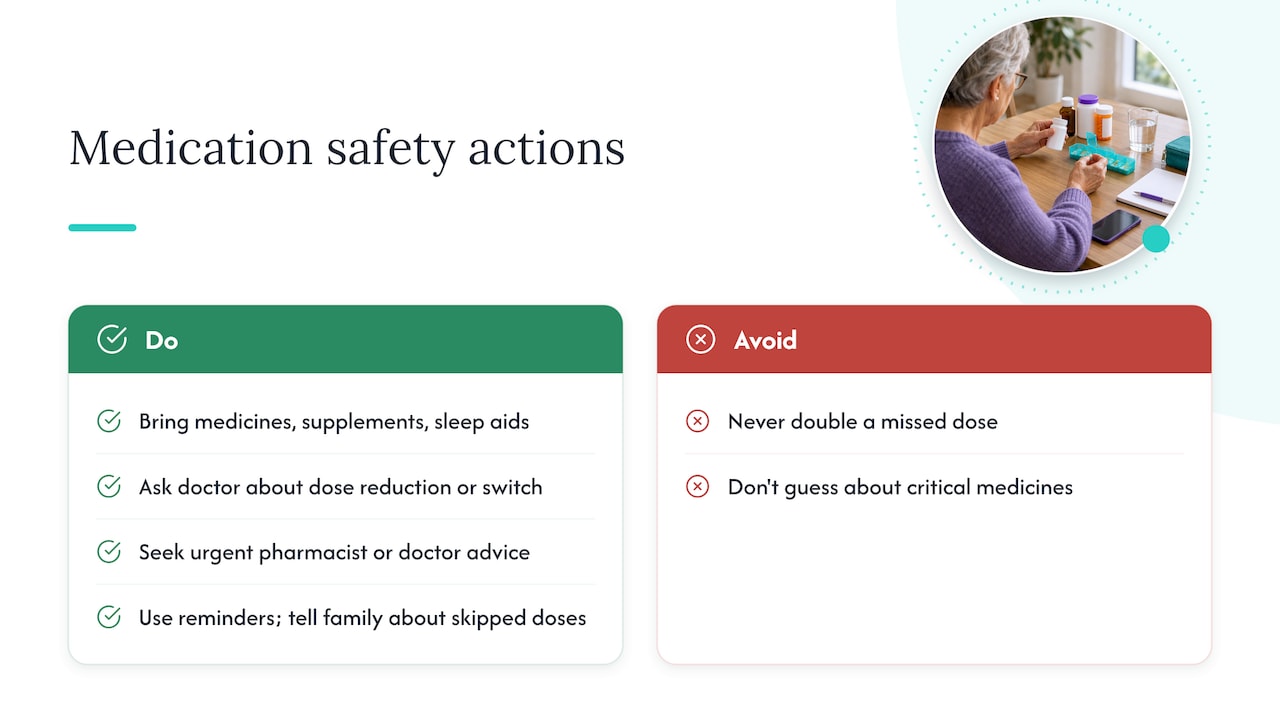
Medicines are one of the most fixable causes of falls. AARP notes that common prescription and over-the-counter drugs can cause dizziness and sleepiness, and a doctor can reduce a dose or switch to a drug without the same effect. Bring every medication, including supplements and sleep aids, to the post-fall appointment.
Missed doses matter too, and so does what you do about them. UK care-home guidance reviewed in 2023 is clear on one point: never double a missed dose. It explains that a missed dose may make a medicine less effective, while doses taken too close together raise the risk of side effects, and that missing epilepsy medicine could trigger a convulsion. For critical medicines, seek urgent advice from a pharmacist or doctor rather than guessing.
Parkinson’s disease shows how serious omissions can be. A Royal College of Physicians presentation reports that patients who missed at least one dose stayed in hospital longer, and that delayed or missed doses can lead to rapid deterioration, including falls. Someone who takes time-critical medicines needs a reliable reminder, and a family needs to know when a dose is skipped.
Well-Check sends medication reminders, and our guides on scheduling medication reminders seniors can rely on and medication adherence strategies at home walk through setting them up. Questions about a particular medicine and its timing belong with the prescribing doctor or pharmacist.
Preventing the next fall
Once the immediate danger has passed, prevention is the second half of the plan. The NHS lists practical steps: strength and balance activities at least twice a week, well-fitting shoes or slippers with good grip, non-slip mats in the bath or shower, grab rails, regular eye and hearing checks, and a review of medicines that could affect balance. Good nutrition, hydration and bone health are on the list as well.
For exercise, a physician or physical therapist should set the starting level, particularly after an injury. For a primer on safe movements, this overview of balance training for seniors explains the basics of exercises that help prevent falls.
For the home itself, our living alone safety checklist for seniors covers room-by-room checks and monthly tests, and the safety plan for seniors gives three moves you can start tonight.
Making sure someone notices
The worst outcome of a fall for a person who lives alone is not the fall itself but the silence afterward. The South-West London adult safeguarding protocols say the consequences of a fall are made worse without quick and appropriate assistance, including pain, injury, loss of confidence and loss of independence. Speed of help is the variable you can control.
A good setup has layers:
- A phone on the body, not in another room.
- A daily check-in that confirms the person is okay at a set time.
- An alert path: if the check-in is missed, specific people hear about it.
- A contact network with clear roles, so it is obvious who calls, who goes over and who calls 911.
- A written plan for what happens at a missed check-in. Our missed check-in protocol lays out the steps.
Perspective
We built Well-Check around a simple observation: most families do not want to watch a parent, they want to know a parent is okay. A fall plan that depends on someone remembering to phone every day will fail on the day everyone is busy. A plan that runs on its own and only interrupts people when something is off holds up better.
That is why the app is designed around one-tap check-ins and “I’m okay” confirmations, with missed check-in alerts going to the emergency contacts your family chose. Medication reminders sit in the same place, so a skipped dose and a skipped check-in are not two separate worries. GPS and smart caregiver analysis are there for the moments when more context helps, and the whole design aims at independence without surveillance.
A fall plan should protect dignity as much as safety. The person who fell decides who is on the list, and the app asks for very little: one tap, once a day.
Brian
How Well-Check fits the plan
Well-Check is a wellness and safety app for people who live alone. It offers daily check-ins, medication reminders, missed check-in alerts to emergency contacts, GPS and an emergency contact network, with one-tap help. The Essential plan costs $5.99 per month and the Complete plan costs $7.99 per month. Compare the plans on our pricing page.
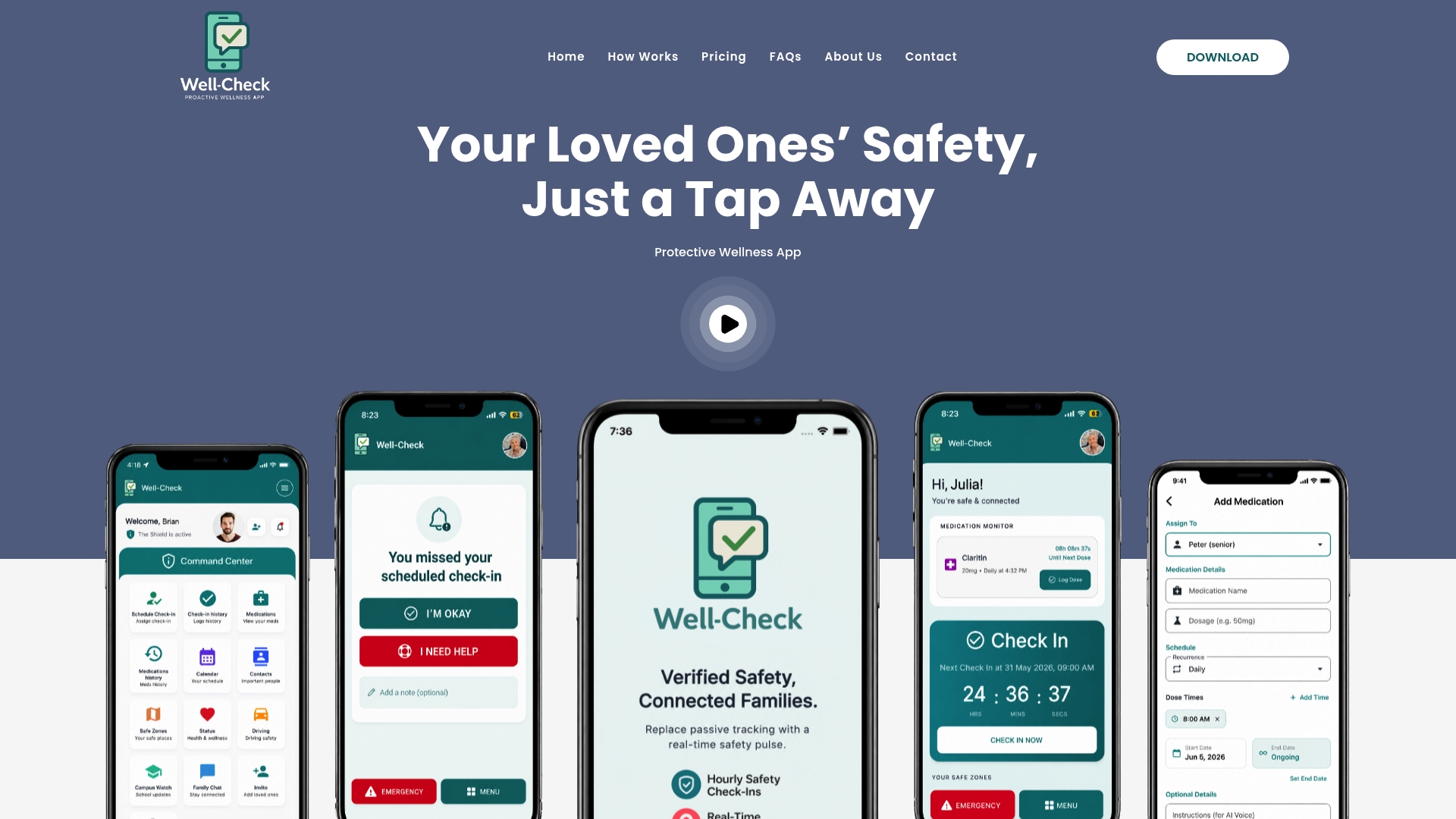
If you are setting this up for a parent, start with the contact list and the check-in time, then add medication reminders. Our guide to daily check-in categories you can set up fast helps you pick what to ask.
Your printable action plan
Copy this onto a card and keep it by the phone.
| Situation | What to do |
|---|---|
| Not breathing, heavy bleeding, unconscious | Call 911. Apply pressure to bleeding. |
| Head, neck, back or hip injury, or cannot get up | Call 911. Do not move the person. |
| Takes blood thinners and fell | Go to the hospital, even with no visible injury. |
| Confusion, drowsiness, vomiting, weakness, speech or vision change | Call 911. |
| Dizziness, severe headache, repeated falls | Call the doctor right away. |
| No injury, feels fine | Call the doctor within days, bring the medication list. |
| Lives alone and cannot get up | Use the phone or alarm, make noise, keep warm, change position about every 30 minutes. |
FAQ
What should I do first after an older adult falls?
Do not lift them. Check whether they are breathing, bleeding, unconscious or confused, and where they hurt. If there is any sign of a serious injury, call 911 and keep them still and warm until help arrives.
Should an older adult go to the hospital after a fall?
Yes, if they take blood thinners, may have broken a bone, or may have hit their head, including delayed symptoms like confusion or drowsiness. Even after a fall with no injury, a doctor visit is advised because a fall can signal a treatable cause.
What if the person fell but seems fine?
Stay close for the next day or two and note any new headache, sleepiness, vomiting, confusion or weakness. Report those to a doctor or call 911 if severe. Then book an appointment to review medications, vision, balance and the home.
What should I do if an older adult misses a medication dose?
Never double the next dose. Timing rules differ by medicine, so check the leaflet or ask the pharmacist or prescriber, and get urgent advice for critical medicines such as epilepsy or Parkinson’s drugs.
Sources
- What to do when you Fall, U.S. Department of Veterans Affairs
- If You Fall or Witness a Fall, Do You Know What to Do?, Public Health Agency of Canada
- Falls, NHS
- Head trauma: First aid, Mayo Clinic
- After a Fall, ECU Health HealthHub
- Common Fall Injury Causes, Treatment & Prevention, Cleveland Clinic
- Post-falls decision tool, NHS Gloucestershire
- Immediate Post-Fall Procedures, ECRI
- Post Fall Multidisciplinary Management Guidelines, Western Australia Department of Health
- Falls in Older Adults: Approach and Prevention, American Family Physician
- Why Falls Can Be Deadly as You Age, AARP
- Missed Doses of Medication in Care Homes, BSW Together
- Parkinson’s on the acute take, Royal College of Physicians
- Medication, falls and pressure ulcers protocols, South-West London adult safeguarding