The exercises that best help prevent falls are balance holds, heel-to-toe walking, sideways steps, heel raises and sit-to-stands. Do them near a sturdy support, about three times a week, and build up slowly. This guide gives you each move step by step, a simple way to progress, and the safety setup that keeps practice from becoming the cause of a fall. If you live alone, we also cover how a daily check-in adds a safety net around the routine.
TL;DR
- Core moves: feet-apart and one-foot standing, heel-to-toe walk, sideways stepping, heel raises and sit-to-stands.
- Frequency: the National Institute on Aging suggests muscle strengthening at least two days a week and balance work about three sessions a week.
- Progress slowly: start with 10-second holds, work toward 30 seconds, and always keep a sturdy surface within reach.
- Check with your doctor or a physical therapist first if your balance is already weak, and stop if you feel chest pain, dizziness or severe shortness of breath.
- Exercise works best alongside a safer home and someone who notices if something goes wrong.
Table of Contents
- Why these exercises are worth your time
- Set up your space before the first exercise
- When to talk to a professional first
- Balance exercises, step by step
- Strength exercises that protect your balance
- How often, and how to progress
- Exercise is one layer, not the whole plan
- Adding a daily check-in around your routine
- Where Well-Check fits
- Our perspective
- FAQ
- Sources
Why these exercises are worth your time
Falls are common, and most are not freak accidents. In the United States in 2020, 14 million older adults (27.6%) reported falling in the previous year, according to the CDC. In 2021, the same CDC report counted 38,742 deaths from unintentional falls among adults 65 and older.
Globally, the World Health Organization estimated 842,000 deaths from falls in 2023, and about 71% of them were among people aged 60 and over.
The encouraging part is that balance is trainable. The WHO’s Step Safely technical package lists exercise that challenges balance among its effective measures for older people, next to reducing hazards at home. In a UK trial of older people in general practice (ProAct65+), a group strength-and-balance program called FaME was linked to fewer injurious falls than usual care: an incidence rate ratio of 0.55, meaning roughly 45% fewer injurious falls over the trial period.
Those are results from structured programs, so treat them as a reason to practice regularly, not a promise for any one person.
Set up your space before the first exercise
Most of what makes balance practice safe happens before you move. Guidance from the Kingston and Richmond NHS Foundation Trust and the Safe Exercise at Home booklet from Australia agrees on the basics:
- A clear, well-lit space. Move rugs, cords and pets out of the way.
- Something sturdy to hold. A kitchen counter, a heavy table or a sturdy chair works. Safe Exercise at Home also suggests having a wall close behind you for steadying.
- Good footwear and clothing. Wear comfortable, supportive, non-slip shoes and loose clothing that does not restrict movement.
- Water within reach. Drink before and after.
- Warm up and cool down. A few minutes of gentle movement, such as marching in place, is enough to start.
- Company when you can. Johns Hopkins Medicine notes that having someone with you during balance work helps with supervision and with catching you if you lose your footing.
Breathe normally throughout. MedlinePlus advises against holding your breath during exercise.
If you are not sure how safe your home is, a room-by-room walkthrough is a good companion to this routine. Our home safety assessment guide covers it.
When to talk to a professional first
If your balance is already weak, if you have had a recent fall, or if you have a health condition that affects walking, talk to your doctor or a physical therapist before you begin. Johns Hopkins Medicine gives this advice, and so does the Otago Exercise Programme guide, which asks you to check with a primary care provider or physical therapist before starting.
Stop right away and seek medical advice if you feel chest pain, dizziness or severe shortness of breath. MedlinePlus also advises talking with a health professional if you have pain, dizziness or breathing problems during or after exercise. If pain lasts more than a few days, Safe Exercise at Home suggests contacting a health professional too.
Balance exercises, step by step
The moves below follow the routines published by Johns Hopkins Medicine, the NHS and the HSE in Ireland. Start with the first one or two, and add the others as they begin to feel easy. For more variations, this page on balance training for seniors is a good next read.
1. Feet-apart standing
- Stand facing a kitchen counter or other stable surface, with your feet about shoulder-width apart.
- Keep your eyes open and your hands near the counter, touching it only if you need to.
- Hold steady for 10 seconds.
- Over the following sessions, work up to 30 seconds.
Where it goes wrong: locking your knees or leaning on the counter. Keep a soft bend in the knees and let the counter be a safety net, not a crutch.
2. Feet together, then one foot
Once the feet-apart stance feels easy, bring your feet together and hold for 10 seconds, building toward 30. Then shift your weight and lift one foot slightly, holding the counter. Johns Hopkins describes progressing through these stances, and, only when the earlier steps are safe with little support, trying them with your eyes closed. Skip the eyes-closed step if you have any doubt, and never do it without something sturdy and a helper nearby.
3. Heel-to-toe walk
- Stand upright, looking straight ahead.
- Place one heel directly in front of the opposite toes, so the feet touch in a line.
- Step forward, placing the other heel in front of the first toes.
- Repeat for several steps, keeping your fingers on a wall if you need to.
Look ahead, not at your feet. Looking down is the most common reason the line wobbles.
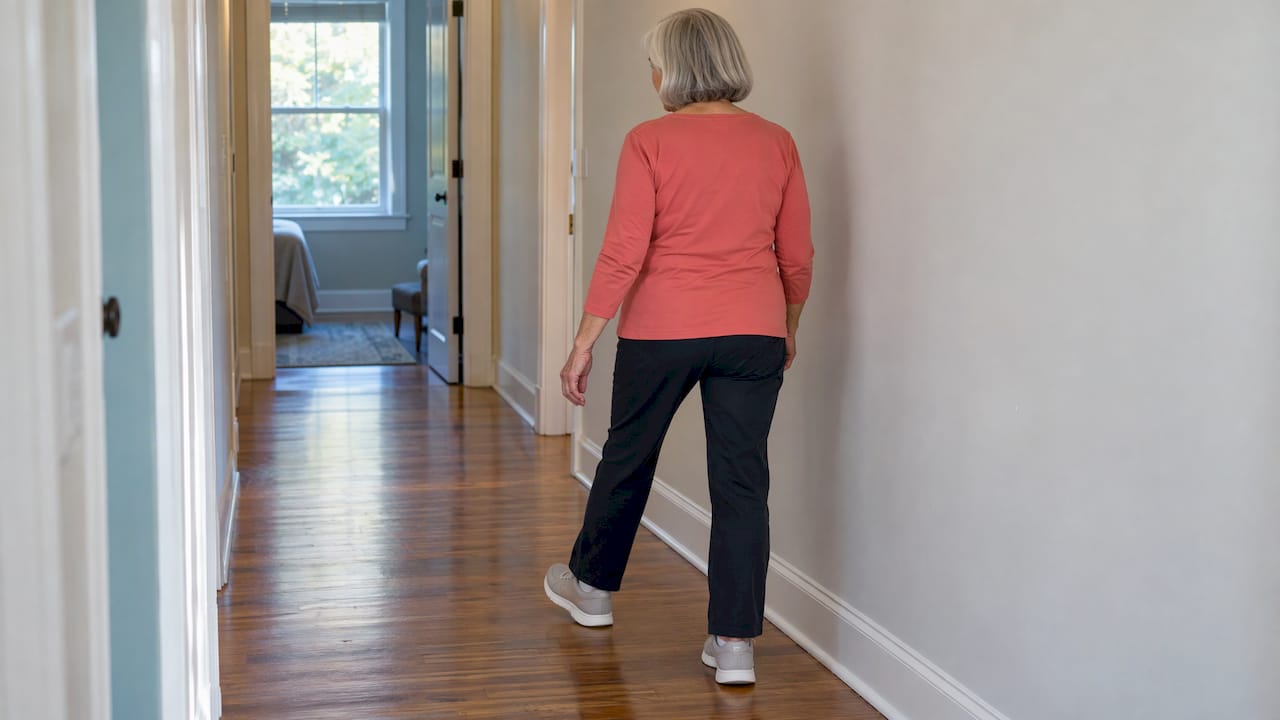
4. Sideways walking
Move one foot out to the side first, then bring the other foot to join it. Keep the pace slow and controlled. Do this along a counter or wall so you can reach it. Reverse direction after several steps.
5. Marching in place
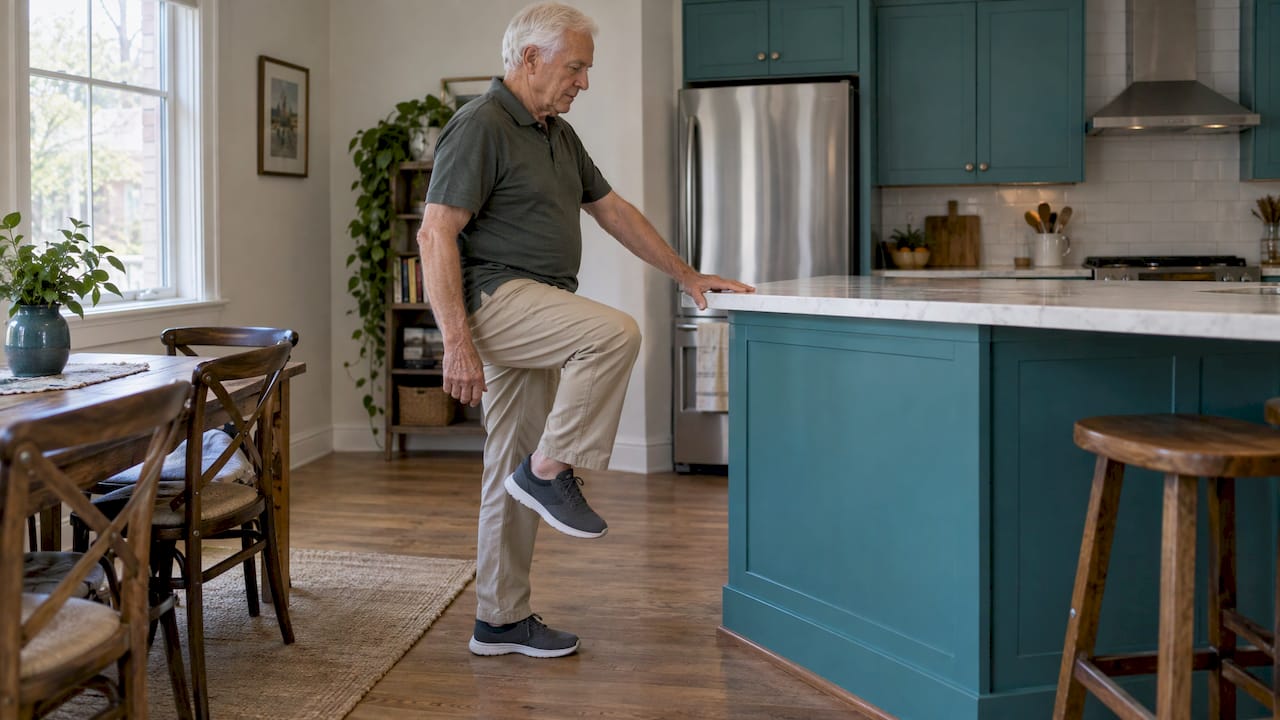
Lift one knee at a time to a comfortable height while holding a support. This doubles as a warm-up and as a gentle balance challenge, because you are briefly on one leg with each step.
Strength exercises that protect your balance
Balance depends on strong legs. These moves also appear in the guidance above, and they use only a chair and a counter.
Heel raises
Hold a solid support, stand with your back straight and your knees slightly bent. Push up onto your tiptoes as high as you can, then lower your heels slowly to the floor, as MedlinePlus describes. The slow lowering matters more than the lift.
Sit-to-stands
Sit toward the front of a sturdy chair. Lean slightly forward and stand up, then lower yourself slowly back down. Use your hands only if you must, and place the chair against a wall so it cannot slide.
Knee raises and side leg raises
Standing with support, lift one knee, lower it, and repeat. For the side leg raise, lift one leg out to the side with your toes pointing forward, keeping your torso upright rather than leaning. Do equal repetitions on both sides.
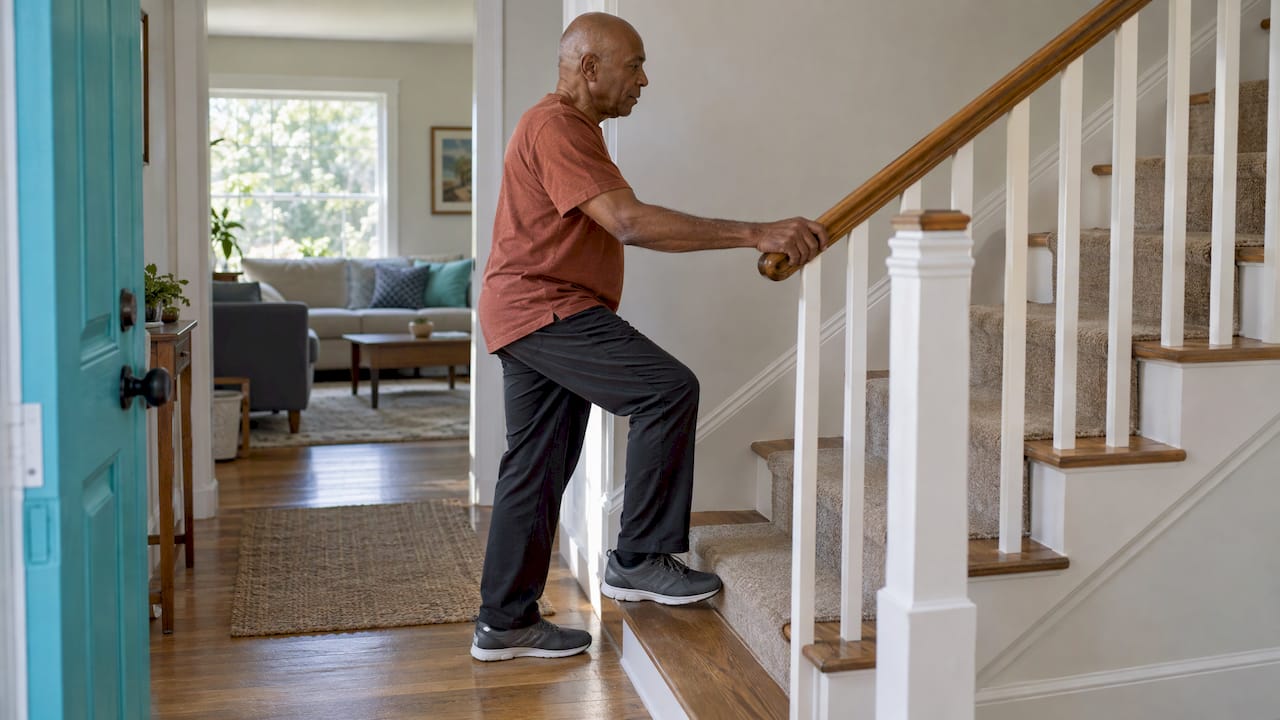
Step-ups
Using a low, stable step and a handrail or counter, step up with one foot, bring the other up to meet it, and step back down. Keep the step low until it feels easy.
How often, and how to progress
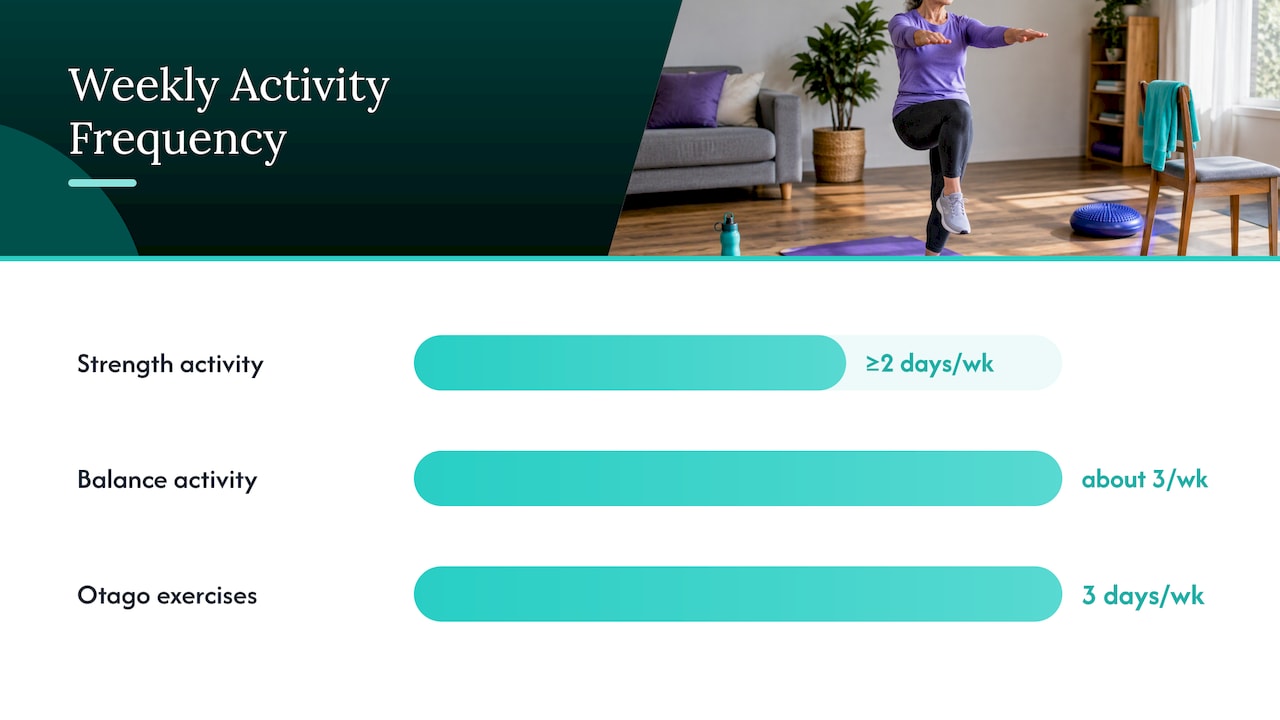
The National Institute on Aging recommends muscle-strengthening activity at least two days a week and balance activities about three times a week. The Otago Exercise Programme guide asks for its prescribed exercises three times a week, with walking on the days in between, and suggests working up to 150 total minutes of exercise and walking.
A simple week might look like this:
| Day | What to do |
|---|---|
| Monday | Balance holds, heel-to-toe walk, sideways walking |
| Tuesday | Walk, plus heel raises and sit-to-stands |
| Wednesday | Balance holds, marching, step-ups |
| Thursday | Walk |
| Friday | Balance work, plus strength moves |
| Weekend | Easy walking, rest |
The NHS and the HSE both give the same advice on progress: start slowly and gradually increase repetitions over time, especially if you have not exercised for a while. A practical rule is to change one thing at a time. Lengthen a hold from 10 seconds to 15, or add two repetitions, or reduce your hand support, but never all three in one week.
If you feel unsteady, make the exercise easier, hold on more firmly or leave it out for the day. Safe Exercise at Home recommends all three options.
The Kingston and Richmond NHS home programme gives a sense of how much time to allow: eight weeks focused on strength and balance, with a booklet completed weekly and weekly phone calls during the first four weeks. Give your routine a similar runway before judging it.
Exercise is one layer, not the whole plan
The WHO’s Step Safely approach treats falls as something to prevent through safer people, safer environments and safer policies. That means exercise belongs with hazard reduction at home, not in place of it. Good lighting, clear walkways and a bathroom that is safe to use all count. Our living alone safety checklist lays out room checks you can repeat monthly.
A second layer is making sure someone would notice quickly if a fall did happen. Many older adults practice balance exercises alone, in the kitchen, when no one else is around. That is where a daily check-in helps. It gives the family a simple signal each day, and it gives you the independence of living on your own terms.
Adding a daily check-in around your routine
Well-Check is a wellness app for people who live alone. You confirm you are safe with a one-tap “I’m okay” check-in. If a check-in is missed, the app alerts the emergency contacts you have chosen. You can also call for help from the same screen.
For someone doing balance exercises at home, a few habits make this work:
- Pick a check-in time that suits your day. Many people tap in after their morning routine, so the check-in confirms the day started well.
- Choose your contacts deliberately. Our guide to building a verified emergency contact list explains how to pick three to five people who will answer.
- Agree on what a missed check-in means. Families should decide in advance who calls first and who visits. Our missed check-in protocol walks through it step by step.
- Keep medications on schedule. Some medicines can cause dizziness, so taking them as prescribed matters for balance. Well-Check sends medication reminders, and our guide to scheduling medication reminders shows how to set them up. If dizziness is new, talk to your doctor or pharmacist.
Where Well-Check fits
If you or a parent practice these exercises at home and live alone, Well-Check gives the routine a safety net: daily check-ins, missed check-in alerts to your emergency contacts, one-tap help and medication reminders, built to keep independence intact. The Essential plan is $5.99 per month and the Complete plan is $7.99 per month. See the details on the Well-Check pricing plans page.

Families who want to see how the app suits an older parent can start from our older adult check-in app page.
Our perspective
Exercise is the part of fall prevention that older adults control themselves, and it is the part we would never want to take away. Strength and balance work builds the confidence to keep walking to the mailbox, climbing the stairs and living in the home you chose.
What we see in the way families talk about this is a simple tension. Parents want independence. Their children want to know they are safe. A routine of 10-second balance holds in the kitchen is exactly the kind of quiet, private progress that deserves respect, and a daily “I’m okay” tap lets it stay private.
That is why we built Well-Check around simplicity and dignity. One tap confirms you are safe. Your emergency contacts hear from us only when something is missed, and your family does not have to call three times a day to find out how you are. You stay in charge, and they get peace of mind.
Practice the exercises, make the home safer, and let a daily check-in cover the moments when you are on your own.
Brian
FAQ
What are the best fall prevention exercises for seniors?
The moves most often recommended are feet-apart and one-foot standing, heel-to-toe walking, sideways stepping, heel raises, knee raises and sit-to-stands. They train balance and leg strength together. Start with a sturdy support in reach and add difficulty gradually.
How often should older adults do balance exercises?
The National Institute on Aging suggests about three balance sessions a week, plus muscle strengthening at least two days a week. Walking on the days in between is a common addition. Start with shorter holds and fewer repetitions, and build up over weeks.
Can I do these exercises if my balance is already poor?
Check with your doctor or a physical therapist first. They can tell you which moves are safe and how much support to use. Have a helper nearby, hold a sturdy surface, and stop if you feel dizzy, have chest pain or struggle to breathe.
Should someone be with me while I exercise?
It is a good idea, especially at the start. Johns Hopkins Medicine notes that company helps with supervision and can steady you if you lose balance. If you exercise alone, keep a counter within reach, and use a daily check-in so your family knows you are doing well.
Sources
- Johns Hopkins Medicine: Fall Prevention, Balance and Strength Exercises
- CDC MMWR: Nonfatal and Fatal Falls Among Adults Aged 65 and Older
- WHO: Falls fact sheet
- WHO: Step Safely
- ProAct65+ trial report: Reducing falls among older people in general practice
- Kingston and Richmond NHS: Home Exercise Programme for Falls Prevention
- Safe Exercise at Home booklet
- MedlinePlus: Exercises to help prevent falls
- Otago Exercise Program patient guide
- NHS: Balance exercises
- HSE: Balance exercises
- NIA: Exercise and Physical Activity for Older Adults