
Yes, monitoring a senior parent or spouse can respect their privacy, but only if you build it on informed consent, role-based access, minimal data collection, and clear notifications about who sees what. The first move isn’t picking a device. It’s sitting down and agreeing, together, on what actually needs watching and what stays off-limits.
TL;DR:
- GPS tracking should be limited to genuine safety needs, as continuous live telemetry exposes excessive personal data and can infringe on privacy.
- Consent must be ongoing and informed, with seniors understanding what is tracked and the ability to revoke access at any time, especially when health conditions change.
- Privacy risks include data breaches and lack of clear breach-notification protocols, which can erode trust and lead seniors to disable devices.
- Monitoring tools should prioritize summaries and role-based access over raw data feeds to reduce invasiveness and protect autonomy.
- Legal considerations vary by state, and appointment of power of attorney does not automatically grant surveillance authority, making legal clarity essential.
Table of Contents
- What Counts as Privacy for Senior Tracking?
- Who Can Legally Authorize Monitoring?
- What Privacy Risks Should Families Actually Worry About?
- How Do You Set Up Monitoring Without Turning It Into Surveillance?
- How Do You Evaluate a Privacy-Respecting Monitoring App?
- Where’s the Line Between Safety and Autonomy?
- What Laws Actually Govern Elder Tracking Beyond Consent?
- Do Cultural Background and Personality Change What Feels Invasive?
- How Do You Get Real Informed Consent From a Senior?
- Can Being Tracked Affect a Senior’s Mental Health?
- How Do Families Actually Talk About This?
- How Well-Check Fits Into a Privacy-First Approach
- Where to Learn More
- Sources
- FAQ
What Counts as Privacy for Senior Tracking?
Privacy for senior tracking means the monitoring setup collects only what’s needed for safety, tells everyone involved who can see that data, and gives the senior real say in the arrangement. It’s the opposite of blanket surveillance. Before choosing any device, know what you’re actually signing up to collect:
- GPS and location tools track movement, sometimes down to the minute, which is useful for wandering risk but excessive for daily errands.
- Wearables log heart rate, glucose, falls, and sleep, often continuously.
- Passive in-home sensors detect motion, door openings, and appliance use without cameras.
- Cameras and microphones capture the most sensitive data of all, including moments most people would never want recorded.
- App check-ins, like a daily “I’m okay” tap, generate the least invasive record: a timestamp, nothing more.
Raw telemetry (a live feed of every movement) exposes far more than a summarized alert (“no activity detected since 9 a.m.”). A scoping review of 34 studies found older adults tolerate passive monitoring far better when it stays out of bathrooms and bedrooms and leaves them some control over what’s tracked. Audio, video, and fine-grained location are the categories to treat with the most caution.
Who Can Legally Authorize Monitoring?
Consent has to come from the senior whenever they have the capacity to give it, and that capacity should be reassessed over time rather than assumed permanent. A diagnosis of mild cognitive decline doesn’t automatically erase someone’s right to weigh in on how they’re watched.
Here’s the part families get wrong most often: a power of attorney does not hand you the right to track someone’s every move. Legal scholar Nina A. Kohn has argued directly that appointing an agent for healthcare or finances does not automatically grant the legal right to monitor a senior’s movements or activities, and monitoring done without consent can cross into unlawful surveillance, even when the motive is protective.
Before you activate anything, work through this list:
- Confirm the senior understands what’s being tracked and why, in their own words, not yours.
- Document that conversation, whether in writing, a recorded call, or notes in the monitoring app itself.
- If health data is involved, ask the vendor for actual proof of HIPAA or GDPR compliance, such as a signed Business Associate Agreement or a third-party audit report, not a marketing bullet point.
- Log every consent transition, including moments when capacity changes and someone else steps in to authorize continued monitoring.
What Privacy Risks Should Families Actually Worry About?
The obvious risk is a data breach. Less obvious: what happens after one.
About half of older adults aren’t sure their monitoring apps respect their privacy at all, according to a 2026 Future of Privacy Forum survey, which put that uncertainty at roughly 51%. The same survey found seniors are far less comfortable with camera-based monitoring than the caregivers who set it up for them, a gap that often goes unnoticed until the senior quietly disables the device.
That disabling behavior isn’t rare. It’s usually a rational response to bad design. IEEE Spectrum’s reporting found that a large share of health-monitoring apps lack basic breach-notification protocols, and their privacy policies are frequently written at a reading level well above what the average older adult reads comfortably. When people can’t understand what a tool does with their data, they either ignore the settings or shut the tool off entirely.
Watch for three warning signs specifically: vendors that quietly use activity data to train other products, apps with no clear breach-notification commitment, and platforms where “family sharing” means everyone sees everything, with no way to limit who gets the raw feed versus a summary.
How Do You Set Up Monitoring Without Turning It Into Surveillance?
Treat this as a sequence, not a shopping list. Skipping the early steps to grab a device with good reviews is how well-meaning families end up with a system nobody trusts.
- Have the consent conversation first, before you buy anything. Agree on what gets monitored, who sees the data, and how long that arrangement lasts.
- Choose summary alerts over raw access. A notification that says “check-in missed” protects safety just as well as a live feed, without exposing every detail of someone’s day.
- Set up role-based access. The adult child who gets emergency alerts doesn’t need the same view as a hired caregiver managing medication schedules. Separate those permissions.
- Revoke access the moment it’s no longer needed. A former caregiver or an estranged relative shouldn’t retain a login just because nobody remembered to remove it.
- Ask the vendor hard questions. Is data encrypted in transit and at rest? Is there a written breach-notification policy? Can you request an audit log of who accessed what and when?
- Simplify the security burden on the senior. Turn on automatic updates, require strong authentication only on the caregiver-facing side, and adjust font size and language settings so privacy controls are actually readable.
- Set a retention limit. Location history and check-in logs don’t need to live forever. Ask for deletion or anonymization of records past a reasonable window, like 90 days.
Pro Tip: Print the consent agreement and post it somewhere visible in the senior’s home, like on the fridge. It sounds simple, but it turns an abstract privacy decision into something the senior can point to and revisit anytime they have second thoughts.
Design researchers covering privacy-by-design for elder care back this same sequence: minimize data collected, build explicit consent workflows, and replace raw telemetry with summaries wherever safety allows it.
How Do You Evaluate a Privacy-Respecting Monitoring App?
Most monitoring apps look identical in an app store screenshot. The differences that matter live in the privacy policy and the settings menu, not the marketing page.
Run any candidate through this checklist before you subscribe:
- Does the privacy policy read in plain language, or does it require a law degree to parse?
- Does the vendor provide real evidence of HIPAA or GDPR adherence, like a signed agreement or a named auditor, rather than a badge with no backing?
- Is there a written breach-notification policy that tells you what happens and how fast if data is exposed?
- Can you see an audit log or consent ledger showing who accessed data and when?
- Does the app default to role-based access and data minimization, or does it dump everything on every family member by default?
- Is there a clear, adjustable retention limit for stored data?
Well-Check builds around several of these principles directly: daily check-ins that generate a simple status rather than a raw feed, summary-based missed-check-in alerts to family, an emergency contact network you configure yourself, GPS tracking that activates around genuine safety needs, and medication reminders that don’t require anyone to watch a live camera. Still, verify the privacy specifics yourself, ask any vendor, Well-Check included, for the trust signals above before you commit to a subscription.
Where’s the Line Between Safety and Autonomy?
There’s no universal answer here, and pretending otherwise does families a disservice. The honest approach treats safety and autonomy as two needs in tension, not a problem to be solved once and forgotten.
A useful test: does the monitoring choice preserve the senior’s ability to make decisions about their own life, or does it quietly transfer that authority to someone else? Passive check-ins that let a senior say “I’m fine” preserve agency. Continuous location tracking that a caregiver checks without ever mentioning it to the senior doesn’t, even when it’s done from a place of love.
Ethicists in aging care generally point to a few working principles. Monitoring should be the least intrusive option that still meets the actual safety need, not the most comprehensive option available. It should be revisited on a schedule, not set once and left alone for years, because a person’s needs and preferences change as health changes. And it should never be imposed unilaterally when the senior is capable of participating in the decision.
The families who navigate this best tend to treat monitoring as a series of small, negotiated agreements rather than one big decision made in a crisis. A fall in the bathroom might justify a motion sensor. It doesn’t automatically justify a camera in the bedroom. Matching the tool to the specific risk, rather than defaulting to the most powerful option available, is usually the difference between monitoring that feels like care and monitoring that feels like control.
What Laws Actually Govern Elder Tracking Beyond Consent?
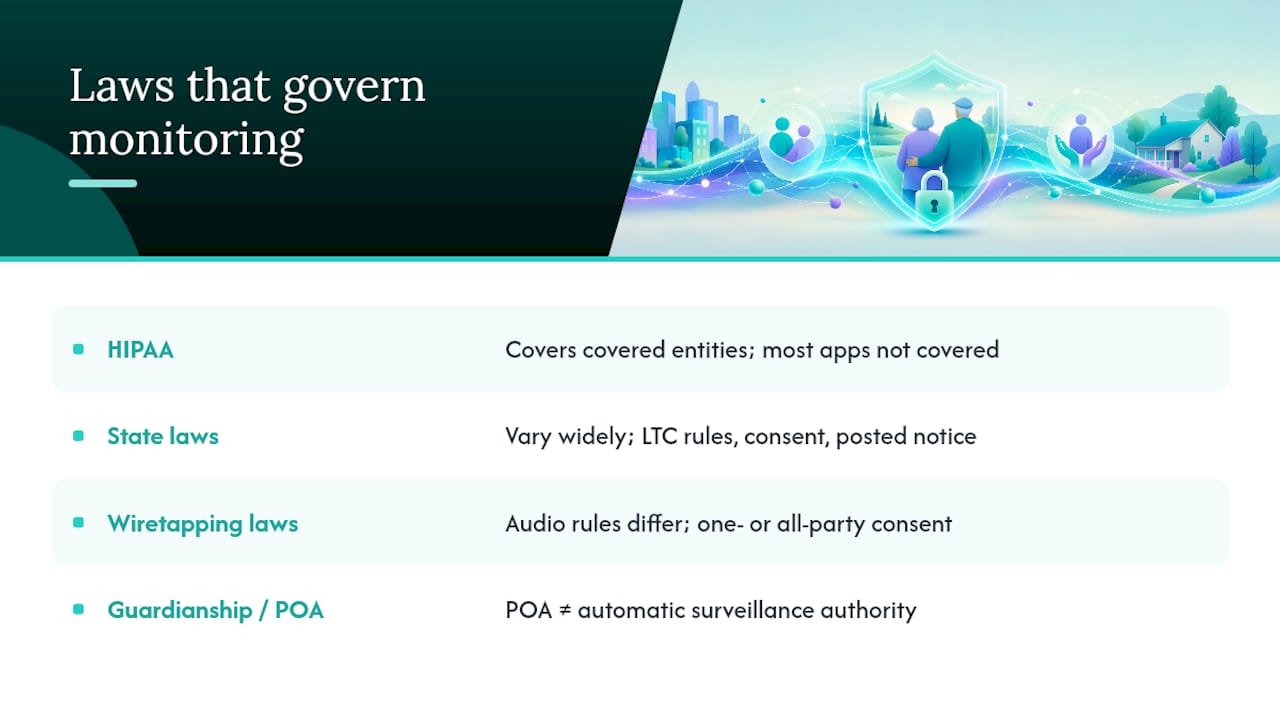
HIPAA covers health information handled by covered entities like clinics, insurers, and their business associates. Most consumer monitoring apps aren’t automatically bound by HIPAA unless they’ve entered a Business Associate Agreement with a covered entity, which is exactly why asking a vendor for that specific paperwork matters more than asking if they’re “HIPAA compliant” in general terms.
State laws add another layer, and they vary considerably. Some states have specific statutes addressing electronic monitoring in long-term care facilities, often requiring resident or guardian consent and posted notice when cameras are in use. Wiretapping and eavesdropping laws, which differ state by state on whether one party or all parties must consent to a recording, can apply to audio-enabled monitoring devices in a home, particularly when the device captures conversations involving people other than the senior being monitored.
Guardianship and power of attorney law is where the most confusion lives. As covered earlier, having financial or healthcare decision authority doesn’t extend automatically to surveillance authority. Some states are beginning to address this gap directly, but coverage is inconsistent, and families operating across state lines, such as an adult child in one state managing care for a parent in another, should not assume the rules are the same in both places.
None of this replaces legal advice specific to your situation. But knowing that “I have power of attorney” and “I have the right to monitor” are legally separate questions will save families from an assumption that can cause real harm.
Do Cultural Background and Personality Change What Feels Invasive?
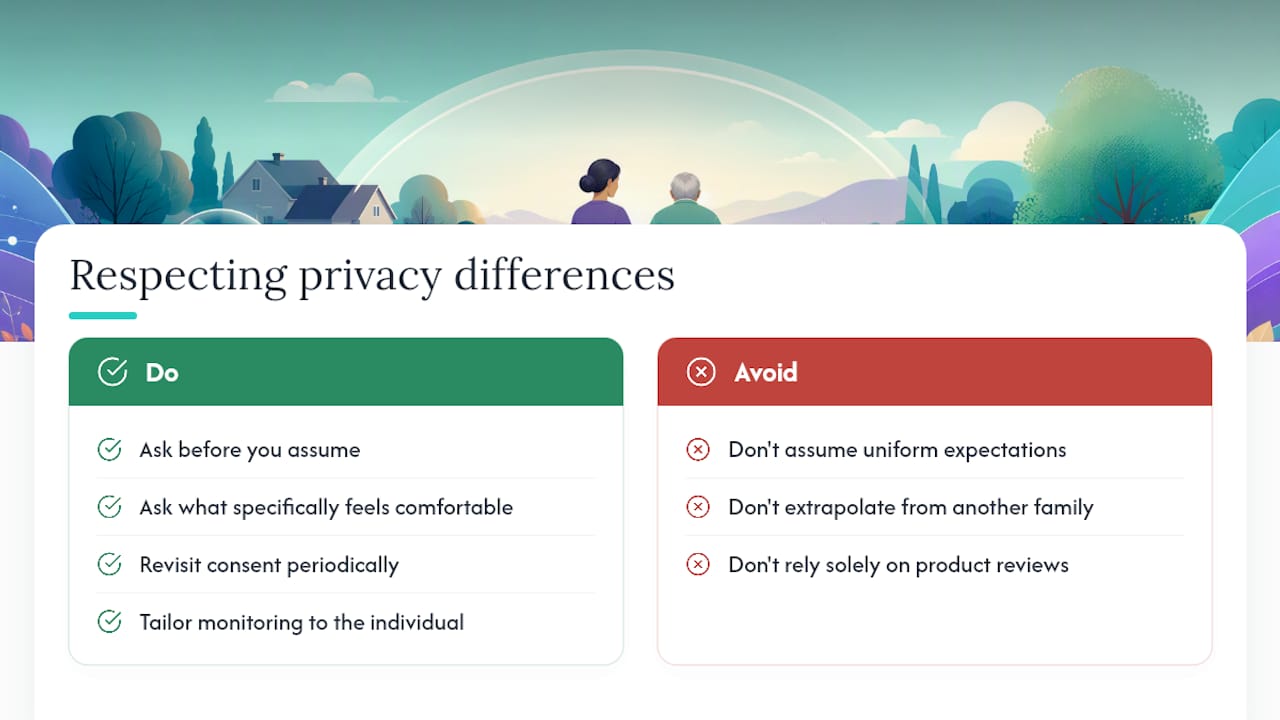
They do, significantly. Privacy expectations aren’t uniform across families, and treating them as if they are is a common misstep.
Some cultural and family traditions treat close-knit, high-visibility caregiving as normal and even expected, where a senior might welcome a family member knowing their whereabouts throughout the day. Other traditions, and plenty of individual seniors regardless of background, place a high value on independence and view any tracking as a loss of dignity, even when it’s well-intentioned. Neither instinct is wrong. They’re just different starting points that require different conversations.
Personality matters just as much as culture. A senior who has always been fiercely private about their schedule will experience a GPS tracker very differently than someone who has always kept family updated on their comings and goings by habit. Assuming your parent will react the way you would in their position, or the way a friend’s parent reacted to a similar setup, is a frequent and avoidable mistake.
The practical takeaway: ask before you assume. Don’t extrapolate from what worked for a neighbor’s family or what a product review site says most users prefer. A short conversation about what specifically feels comfortable, and what specifically feels invasive, will tell you more than any general rule about cultural norms or personality types ever could. Revisit that conversation periodically too, since comfort with monitoring often shifts as health status and trust in the system change over time.
How Do You Get Real Informed Consent From a Senior?
Getting genuine consent starts with dropping the jargon. Explain in plain terms what the device tracks, who sees the results, and what happens if something looks wrong, using the same words you’d use describing it to a friend, not the language from the privacy policy.
Check comprehension actively rather than assuming a nod means understanding. Ask the senior to explain the arrangement back to you in their own words. If they describe it differently than you intended, that’s valuable information, not an inconvenience.
Frame the conversation around specific scenarios instead of abstract permissions. “If you don’t check in by 10 a.m., I’ll get a text” is concrete and easy to evaluate. “We’re going to monitor your activity” is vague enough to trigger anxiety without giving the senior anything specific to agree or disagree with.
Consent isn’t a single event. Build in a review date, whether that’s every three months or every six, where you revisit the arrangement together and ask whether it still feels right. Circumstances change: a fall, a diagnosis, a recovery, and consent given a year ago might not reflect how someone feels today. Treating consent as a standing conversation rather than a signed form filed away is what actually respects the senior’s ongoing say in their own life.
Can Being Tracked Affect a Senior’s Mental Health?
It can, and the effects aren’t always obvious from the outside. Feeling watched, even by people who love you, can produce a quiet but persistent sense of losing independence. Some seniors report feeling like a burden or a liability rather than a person, particularly when monitoring is introduced after a health scare without much discussion beforehand.
Isolation is a subtler risk. When monitoring becomes a substitute for actual contact, a family checks the app instead of calling, the senior can end up more alone despite being more “watched” than ever. The data point replaces the relationship instead of supporting it.
A few mitigation strategies help. Frame monitoring as one part of staying connected, not a replacement for calls and visits. Give the senior visibility into their own data, so they’re not the only person in the household who doesn’t know what’s being recorded. And watch for signs that monitoring itself is becoming a source of stress, like a senior who becomes anxious about being “in trouble” for a missed check-in. If that happens, scale back to something lighter, like a simple daily tap-in, rather than adding more oversight in response.
How Do Families Actually Talk About This?
Bring both concerns to the table honestly: you’re worried about safety, and they’re worried about being watched. Neither concern cancels the other out, and naming both up front tends to lower defensiveness on both sides.
Use plain language, ask them to repeat back what they heard, and put the agreement somewhere both of you can see it again later. Set a date, maybe every few months, to ask whether the setup still feels right, because needs shift and so should the arrangement.
If your parent pushes back on a camera or constant GPS, don’t dig in. Offer the lighter option first, a daily check-in or a summary alert, and let the relationship, not the device, stay the priority.
— Brian
How Well-Check Fits Into a Privacy-First Approach
Well-Check is built around a simple idea: safety monitoring doesn’t require putting a camera on someone’s daily life. Rather than a continuous feed, the app relies on daily check-ins, so a senior taps “I’m okay” and family only hears about it if something’s off. That single design choice separates it from monitoring approaches built on constant surveillance.
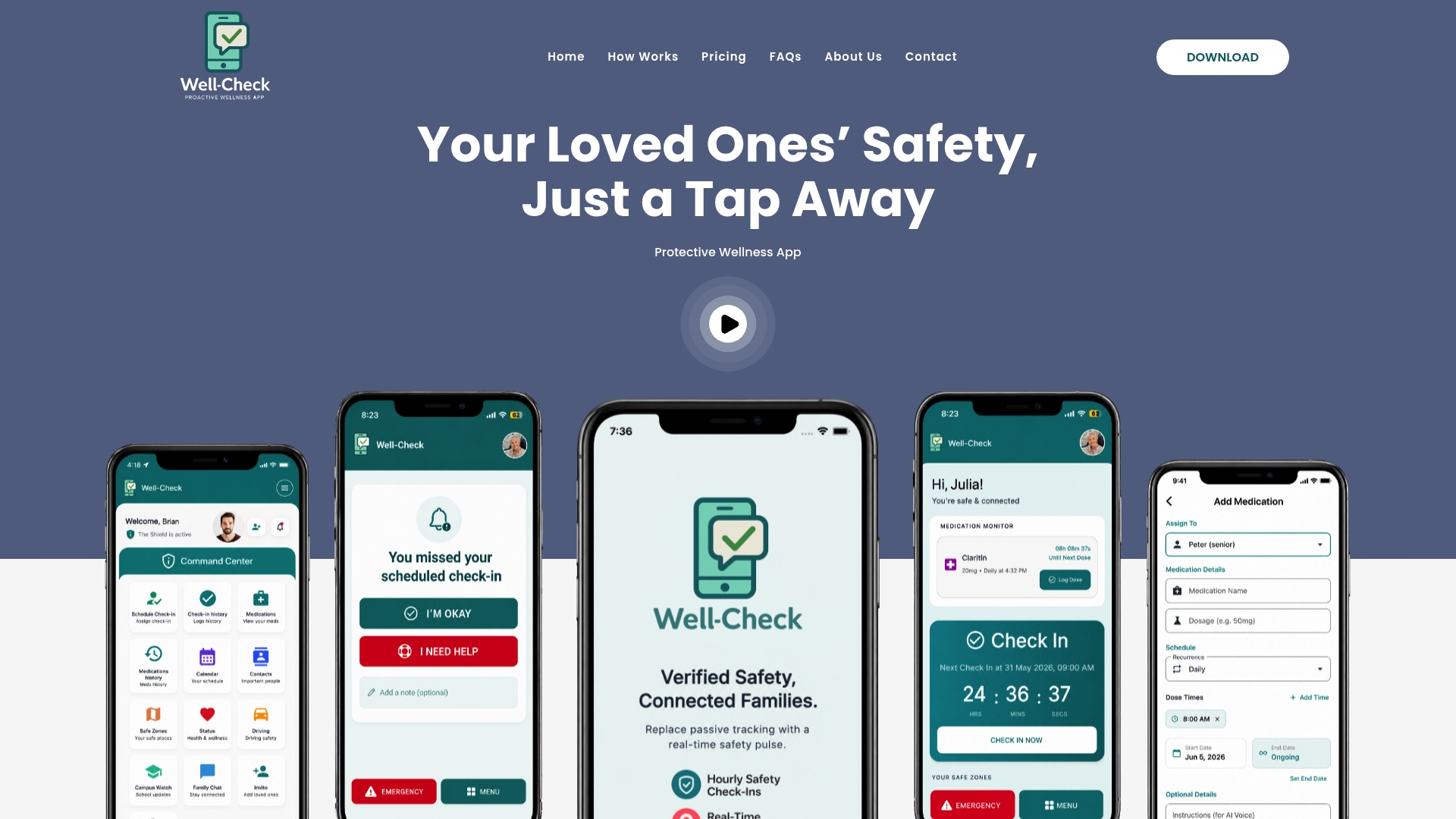
The features line up with the checklist covered above: missed check-in alerts that notify an emergency contact network instead of exposing raw activity data, medication reminders that support daily routines without tracking every movement, and GPS tracking that activates for genuine safety needs rather than running continuously in the background. Smart caregiver analysis helps families spot patterns worth a phone call, without turning a parent’s home into a surveillance zone.
Before subscribing to any monitoring app, including this one, verify the specific privacy practices, retention policies, and access controls that matter to your family. Well-Check’s Essential plan runs $5.99 a month, and the Complete plan is $7.99 a month. Compare what’s included in each and see which fits your situation on the pricing page.
Where to Learn More
The claims in this article draw on a specific set of sources worth reading directly if you want the fuller legal and research context:
- Nina A. Kohn’s legal analysis of AgeTech and surveillance risk in Forbes
- The Future of Privacy Forum’s 2026 survey on AgeTech adoption barriers
- IEEE Spectrum’s engineering and usability findings on health-tech privacy gaps
- The Cambridge scoping review on older adults’ privacy perceptions
- The U.S. Caregiver Playbook on medical alert scams for fraud red flags specific to monitoring services
This article is general information, not a substitute for advice from a qualified doctor. Consult a qualified healthcare professional about your own circumstances before acting on anything here.
Sources
- AgeTech Is Transforming Eldercare But Risks Abusive Surveillance — Forbes
- New survey: Privacy concerns are a top barrier to AgeTech adoption among older adults — Future of Privacy Forum
- Privacy concerns in health tech for seniors — IEEE Spectrum
- Older adults’ privacy perceptions of passive in‑home monitoring technologies: a comprehensive scoping review — Ageing & Society (Cambridge Core)
FAQ
Is It Legal to Track a Parent Without Telling Them?
Generally no, unless they lack decision-making capacity and a court or documented process has authorized substitute decisions. Legal scholar Nina A. Kohn has warned that power of attorney alone doesn’t grant monitoring rights, so covert tracking of a capable adult can expose families to legal risk even when intentions are good.
What’s the Least Invasive Way to Monitor a Senior’s Safety?
A daily check-in app, where the senior actively confirms they’re okay, is far less invasive than GPS tracking or cameras. Summary alerts that only notify family when a check-in is missed protect safety without exposing continuous activity data.
Does Well-Check Comply With HIPAA or GDPR?
Specific compliance details and current documentation are available directly on Well-Check’s site rather than summarized secondhand. Always ask any monitoring vendor, including Well-Check, for written evidence like a Business Associate Agreement before sharing health data.
How Much Does Well-Check Cost?
Well-Check offers two plans: Essential at $5.99 per month and Complete at $7.99 per month. Full plan details and features are listed on the pricing page.
What Should I Do if My Parent Refuses Monitoring?
Start smaller. Offer a simple daily check-in instead of GPS or cameras, and revisit the conversation after a few weeks rather than pushing for full monitoring immediately. Respecting an initial “no” while proposing a lighter alternative tends to build more long-term cooperation than insisting on the most comprehensive option upfront.