Loneliness in older adults is a common, serious and treatable health concern. It is linked to depression, heart disease, cognitive decline and earlier death. It is also easier to ease than most families expect. Small, steady routines of contact work better than occasional grand gestures. This guide explains the difference between loneliness and social isolation, why risk rises with age, which signs to watch for, what the evidence says helps, and how to protect your own health if you are the one providing care.
TL;DR
- Loneliness is a painful feeling. Social isolation is a lack of contact. An older adult can have one without the other, so ask about both.
- In a 2023 national poll, about 37% of US adults aged 50 to 80 reported loneliness, and 34% reported feeling socially isolated.
- Both are tied to higher risks of depression, dementia, heart disease and early death, according to the National Institute on Aging.
- What helps most: regular, active participation in groups and activities, plus steady contact from family. A daily check-in habit is an easy base to build on.
- Caregivers burn out too. Know the signs and get respite before you hit a wall.
Table of Contents
- Loneliness and social isolation are not the same thing
- How common is loneliness among older adults?
- Why risk rises with age
- What loneliness does to health
- Signs a parent or neighbor may be lonely
- What actually helps
- Daily check-ins as a connection habit
- Our perspective
- When the caregiver is the one running on empty
- What Well-Check offers
- FAQ
- Sources
Loneliness and social isolation are not the same thing
The two terms get used as if they meant one thing. They do not, and the difference changes what you do about it.
The National Institute on Aging explains that social isolation is the lack of social contacts, having few people to interact with regularly. Loneliness is the distressing feeling of being alone or separated. The same publication notes that a person can feel lonely while surrounded by others, and can live alone without feeling lonely or isolated.
The National Council on Aging puts it in terms of relationships. Isolation means few relationships or limited contact, while loneliness is the sense that your relationships do not give you the connection you want or need. It also uses “social disconnection” as a broader term covering both.
In practice:
| Situation | Likely issue | What to try |
|---|---|---|
| A widower who sees no one for days but says he is content | Isolation, not necessarily loneliness | Gentle, low-pressure routines of contact |
| A retiree with a full calendar who says she feels unseen | Loneliness without isolation | Conversations about the quality of connection, not just the quantity |
| A parent who lives alone, rarely goes out and says she is miserable | Both | Rebuilding contact and meaning together |
This is why “does Dad have enough visitors?” is the wrong first question. Start with “how do you feel about your days?” and then look at who he actually talks to.
How common is loneliness among older adults?
More common than most families realize. The numbers vary by survey, age band and definition, so treat them as a range rather than a single figure.
- In the 2023 national poll cited by JAMA, 37% of adults aged 50 to 80 experienced loneliness and 34% reported feeling socially isolated.
- The World Health Organization says around 16% of people worldwide experience loneliness, and about 11.8% of older people.
- A WHO technical document reports that 25 to 29% of older people in the USA reported being lonely, compared with 18% in India and 3.8% in China. The same document cites a review finding that 35% of older people in residential and nursing care homes were very lonely.
The spread between 11.8% and 37% comes mostly from who was asked and how. The takeaway does not change: a large share of older Americans are affected, and living in a facility does not protect anyone.
Why risk rises with age
Loneliness rarely has a single cause. It builds from several losses and barriers stacking up.
The NIA says older adults face higher risk because of changes in health and social connections: hearing, vision and memory loss, physical disability, trouble getting around, and the loss of family and friends. JAMA adds that loss of a partner, chronic illness, lack of transportation and stopping favorite activities all raise the risk.
A guide from Healthy Aging North Carolina groups the risk factors into social, psychological, physical, economic and logistical categories. They include living alone, depression, poor health, limited financial resources and lack of transportation.
The WHO also notes that some groups face extra risk, including caregivers, people with disabilities and older people in residential or nursing care. That last point matters for this article. The person caring for a lonely parent may be lonely too.
Hidden barriers worth checking first
Before assuming a parent “doesn’t want to socialize,” rule out the practical blockers:
- Hearing or vision changes that make group conversations tiring.
- Transportation. If they stopped driving, many activities simply became unreachable.
- Cost. Clubs, classes and outings add up on a fixed income.
- Health worries, such as fear of a fall while out alone.
- Grief, which can make old social routines feel pointless.
Solving one of these often does more than any amount of encouragement.
What loneliness does to health
This is not only about mood. The NIA states that socially isolated or lonely people are more likely to be admitted to a nursing home or the emergency room. It links both conditions with higher risks of obesity, weakened immune function, depression, high blood pressure, cognitive decline, heart disease, anxiety, dementia including Alzheimer’s disease, and death.
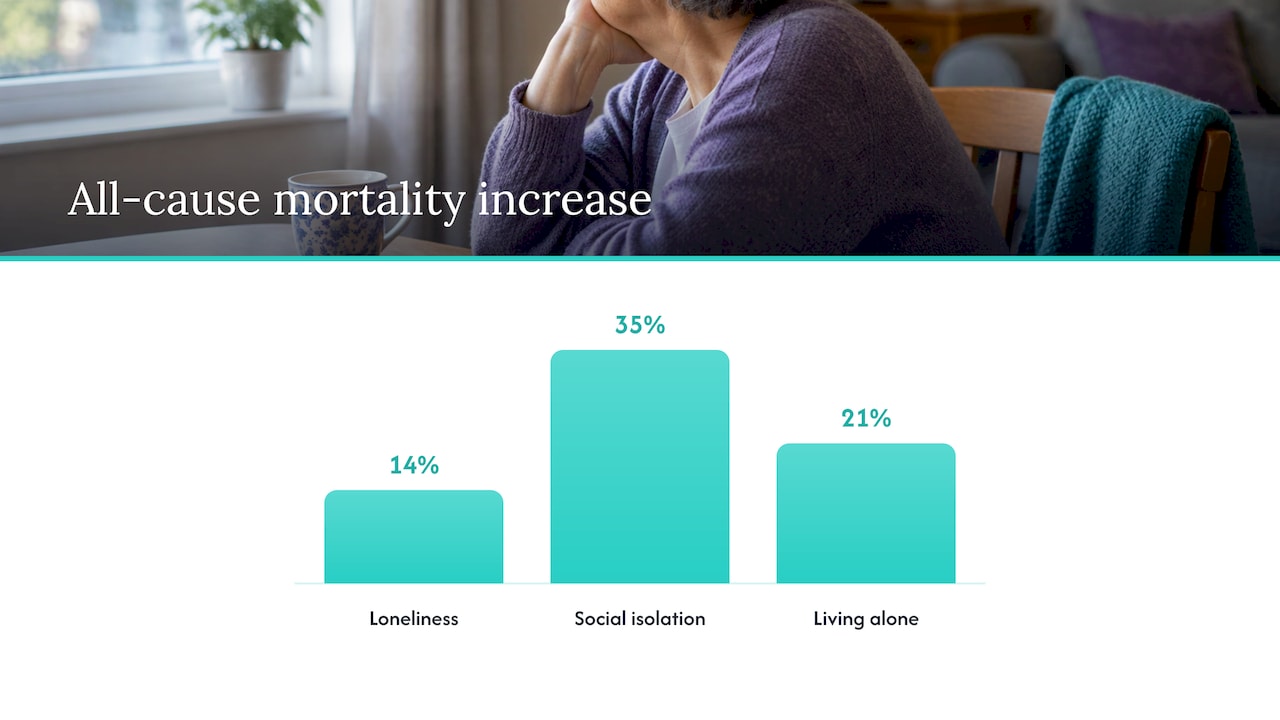
The mortality data is the starkest. A 2025 systematic review and meta-analysis of 86 studies found that in older adults loneliness was associated with a 14% increase in all-cause mortality risk, social isolation with a 35% increase, and living alone with a 21% increase. These are associations, not proof that loneliness alone causes the deaths, but the pattern is consistent.
The WHO calls social isolation and loneliness important but often neglected social determinants of health, and the US Surgeon General has identified them as public health concerns, as JAMA reports. The same JAMA piece notes that better social connection is associated with longer life and better social, emotional and physical well-being.
The Healthy Aging NC guide describes two routes of harm: direct physiological changes and indirect negative health behaviors. Think skipped meals, missed medication and less movement. Those indirect routes are the ones families can actually see and act on.
Signs a parent or neighbor may be lonely
Older adults often will not say “I’m lonely.” Many feel it is embarrassing or that they are burdening you. Look for changes from their own normal:
- Fewer calls and outings, or turning down invitations they used to accept.
- Neglected routines: unopened mail, an emptier fridge, missed appointments, medication left untouched.
- Mood shifts: flatness, irritability, tearfulness, or talking about feeling like a burden.
- Long phone calls that they are reluctant to end, or repeated calls with nothing specific to say.
- Changes in sleep, appetite or self-care.
None of these proves loneliness, and several can signal depression or a medical problem. If you notice a lasting change, mention it to their primary care clinician. If a parent talks about hopelessness or self-harm, call or text 988, the Suicide and Crisis Lifeline, or call 911 in an emergency.
What actually helps
The good news is that interventions exist, and the research points to a few principles.
Active beats passive. A 2021 systematic review of 24 randomized trials found that 18 showed an effect on at least one dimension of social isolation. Interventions in social and public places had more obvious effects, and those where older people were active participants were more likely to work. Being a member, a volunteer or a team-mate beats being a recipient of visits.
Options are broad. The WHO lists social skills training, community and support groups, befriending and cognitive behavioural therapy, delivered face to face or digitally. It also points to better transportation and access to technology.
Personalize it. The Canadian clinical guidelines on social isolation and loneliness in older adults recommend screening with validated tools, a comprehensive assessment and individualized interventions. Those include social prescribing, social and physical activity, psychological therapies, animal-assisted therapies, leisure skill development and technology. The guidelines also favor shared decision-making, meaning the older adult chooses with you rather than being managed.
Practical ways to start
- Pick one anchor activity tied to something they already love: a book club, church group, walking group, garden club, senior center class.
- Solve the ride. A standing weekly lift from a neighbor or volunteer driver can unlock everything else.
- Build a rhythm of contact. A predictable 10-minute call at the same time each day beats a long call once a month.
- Look at faith and community groups if your parent values them. Faith-based support for loneliness shows how small steps toward a welcoming community can ease the feeling of being alone.
- Use technology as a bridge, not a replacement: video calls with grandchildren, online interest groups, simple apps for staying in touch.
- Raise it with their doctor. Hearing aids, treatment for depression or a medication review can remove barriers you cannot fix by encouragement.
Daily check-ins as a connection habit
A check-in is not a substitute for friendship. But it gives a lonely person a small, reliable moment of being noticed, and it gives you a way to catch changes early, before they become emergencies.
The most useful check-ins are short, predictable and respectful. Our guide to one-tap daily check-in categories shows how to keep them quick. If you are unsure how often to reach out, see how many weekly check-ins seniors need and when to automate.
Some tips that keep dignity intact:
- Agree on the check-in with your parent, not for them.
- Keep the question simple. “I’m okay” should take one tap.
- Decide in advance who is called if a check-in is missed, and write it down. Our missed check-in protocol walks through the steps.
- If you use location features, agree on rules first. Our location sharing etiquette guide covers how to do that without it feeling like surveillance.
- Build a verified circle of three to five people rather than relying on one. See how to build an emergency contact list.
When the check-in is also a chance for a real exchange, a joke, a question about the garden, a photo from the grandkids, it does double duty.
Our perspective
Brian here. Families usually come to us worried about safety: what if Mom falls, what if Dad misses his pills. But when we talk it through, the worry underneath is often about distance. Someone they love spends most of the day alone, and they cannot tell how that feels.
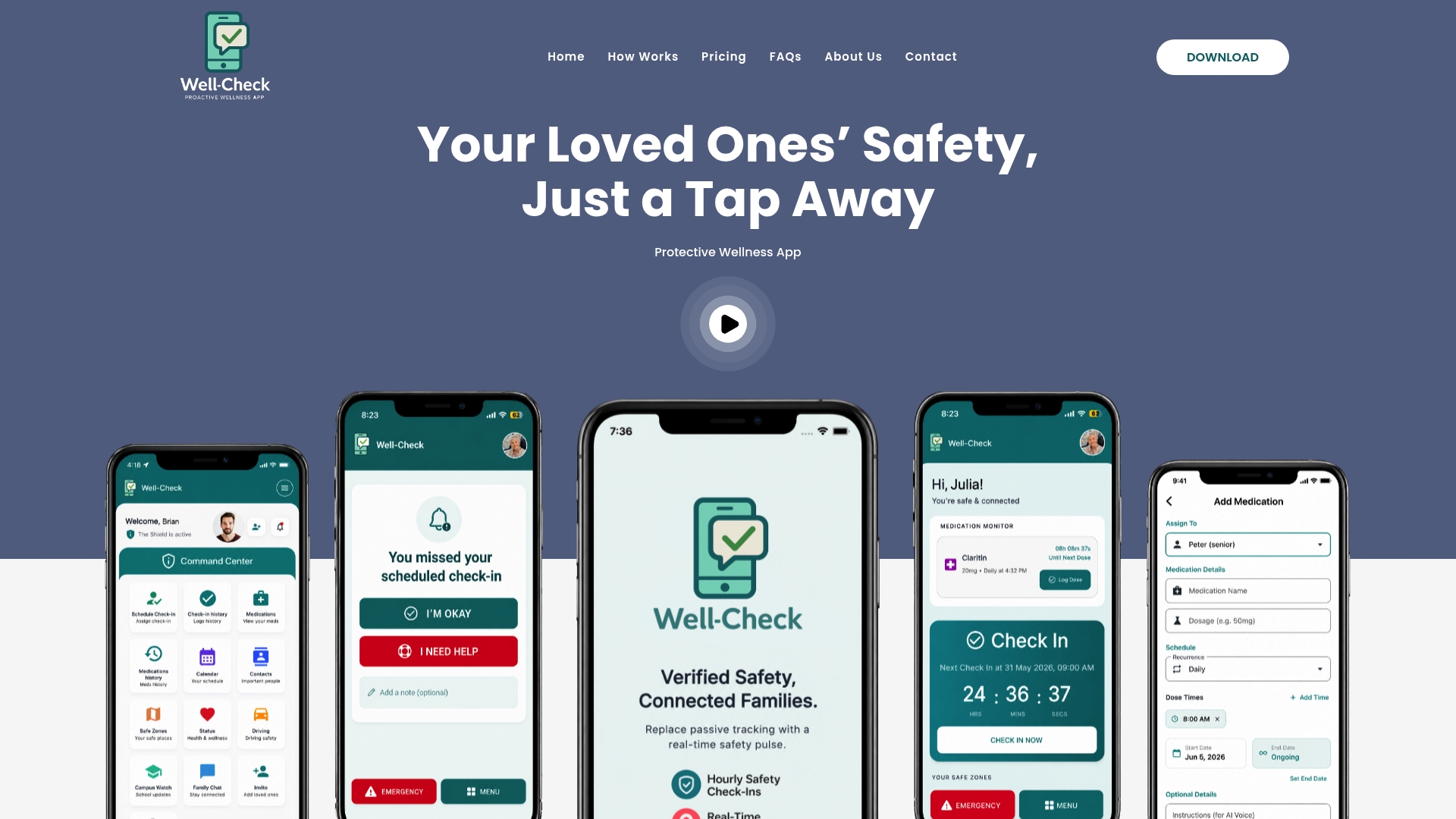
We built Well-Check around a simple belief: older adults should keep their independence and their dignity, and families should not have to choose between hovering and hoping. Our app is designed for simplicity, with one-tap check-ins, medication reminders, missed check-in alerts to an emergency contact network, and optional GPS and smart caregiver analysis, all meant to reduce intrusion while raising peace of mind.
What we see is that a reliable daily touchpoint changes the tone of a relationship. When a parent taps “I’m okay” each morning, the call that follows becomes about life, not about logistics. When a check-in is missed, the right people hear about it quickly, and nobody has to nag.
Technology does not replace friends, clubs, faith communities or a good doctor. It gives the people around an older adult a steadier way to stay present, so more of their energy goes to real connection.
Brian
When the caregiver is the one running on empty
Caregivers keep appearing in the research on isolation, and the three search topics families raise most, caregiver stress, fatigue and burnout, belong in this conversation. A caregiver who is exhausted cannot offer the warmth a lonely parent needs.
Signs of caregiver burnout
The American Medical Association’s guide for physicians lists common signs of caregiver burnout:
- Feeling overwhelmed or constantly worried
- Feeling tired often
- Getting too much or too little sleep
- Gaining or losing weight
- Becoming easily irritated or angry
- Losing interest in activities once enjoyed
- Feeling sad
- Frequent headaches or bodily pain
- Misusing alcohol or drugs, including prescription medications
The same guide reports that almost 25% of caregivers giving more than 40 hours of care a week say their own health has deteriorated, and more than half of surveyed caregivers say their health decline has affected their ability to provide care.
The Parkinson’s Foundation draws a useful line between stages. It defines caregiver strain as persistent problems and decreased well-being from prolonged care, and says unaddressed strain progresses into burnout, a state of physical, emotional and mental exhaustion that may include a shift from caring to unconcerned. Catching strain early is the whole game.
If several of these signs are present, talk to your own doctor. If you feel hopeless or unsafe, call or text 988.
How to prevent caregiver burnout
Respite is the most direct tool, and most caregivers never get it. A guide from USAging, funded by the Administration for Community Living, reports that approximately 86% of caregivers of adults do not receive respite. Reasons include lack of awareness, time or money, scarce services and complex eligibility. The guide says respite can improve caregiver health, resilience and family relationships, and can delay or avoid facility-based placement.
Practical steps:
- Ask about respite through your local Area Agency on Aging. It is often the front door to local services.
- Share the load. Write down who does what. Our guide to caregiver roles and responsibilities gives a five-step way to divide tasks among family.
- Automate the repetitive parts. Daily check-ins and medication reminders do not need you to remember them. See how to schedule medication reminders.
- Get a break fast. Our four operational steps to a real break within 24 hours is built for the day you realize you are done.
- If you live far away, a structured plan helps. Try a 45-minute family meeting plan for long-distance caregiving.
- Keep one thing that is yours: a walk, a call with a friend, a class. Caregivers are at risk of isolation too.
What Well-Check offers
Well-Check is a wellness and safety app for people who live alone and the families who care about them. It offers daily check-ins with one-tap “I’m okay” confirmations, medication reminders, missed check-in alerts to your emergency contacts, an emergency contact network, GPS features and smart caregiver analysis. It also offers advanced scheduling and unlimited check-ins.
There are two plans, Essential at $5.99 per month and Complete at $7.99 per month. You can compare them on our pricing plans page. If you are setting this up for a parent who lives alone, start with our page for the older adult wellness check-in app.
We designed it so a parent can stay independent while the people who love them stay informed, without anyone feeling watched.
FAQ
What is the difference between loneliness and social isolation?
Social isolation is an objective lack of contact with other people. Loneliness is the painful feeling that your connections are not enough. The NIA notes that someone can be lonely in a crowd or live alone and feel fine, so it helps to ask about both feelings and habits.
Is loneliness in older adults really a health risk?
Yes. The NIA links loneliness and social isolation to higher risks of depression, heart disease, dementia and death. A 2025 meta-analysis found loneliness associated with a 14% higher risk of death from any cause in older adults, and social isolation with a 35% higher risk. These are associations, so talk with a doctor about any concerns.
How can I help a parent who says they are fine but seems withdrawn?
Start by listening, then look for practical barriers such as hearing, transportation or cost. Offer a specific, active option they can choose, like a group or volunteer role, rather than general advice. Add a short daily contact routine, and mention lasting changes in mood or habits to their doctor.
What are the first signs of caregiver burnout?
Common early signs include constant worry, frequent tiredness, sleep changes, irritability, losing interest in things you enjoyed and feeling sad, according to the American Medical Association. Headaches or body pain can also appear. If these persist, see your own doctor and look into respite care.
Can an app reduce loneliness?
An app is not a replacement for human relationships. A daily check-in can make contact more regular and help families notice changes sooner, which makes room for more meaningful conversations. Research favors active participation in groups and activities, so use technology to support those too.
Sources
- Social Isolation and Loneliness in Older Adults, JAMA
- Loneliness and Social Isolation: Tips for Staying Connected, National Institute on Aging
- Understanding Loneliness and Social Isolation, National Institute on Aging
- Social Isolation vs. Loneliness, National Council on Aging
- Reducing social isolation and loneliness among older people, World Health Organization
- Social isolation and loneliness among older people, World Health Organization technical document
- Loneliness, social isolation, and living alone: a systematic review and meta-analysis
- Reducing Loneliness and Social Isolation Among Older Adults, Healthy Aging NC
- Systematic Review of Efficacy of Interventions, Frontiers in Psychology
- Canadian Clinical Guidelines on Social Isolation and Loneliness in Older Adults
- Caring for the caregiver: A guide for physicians, American Medical Association
- Caring for the Care Partner, Parkinson’s Foundation
- Advancing the Availability of Flexible and Accessible Respite, USAging